
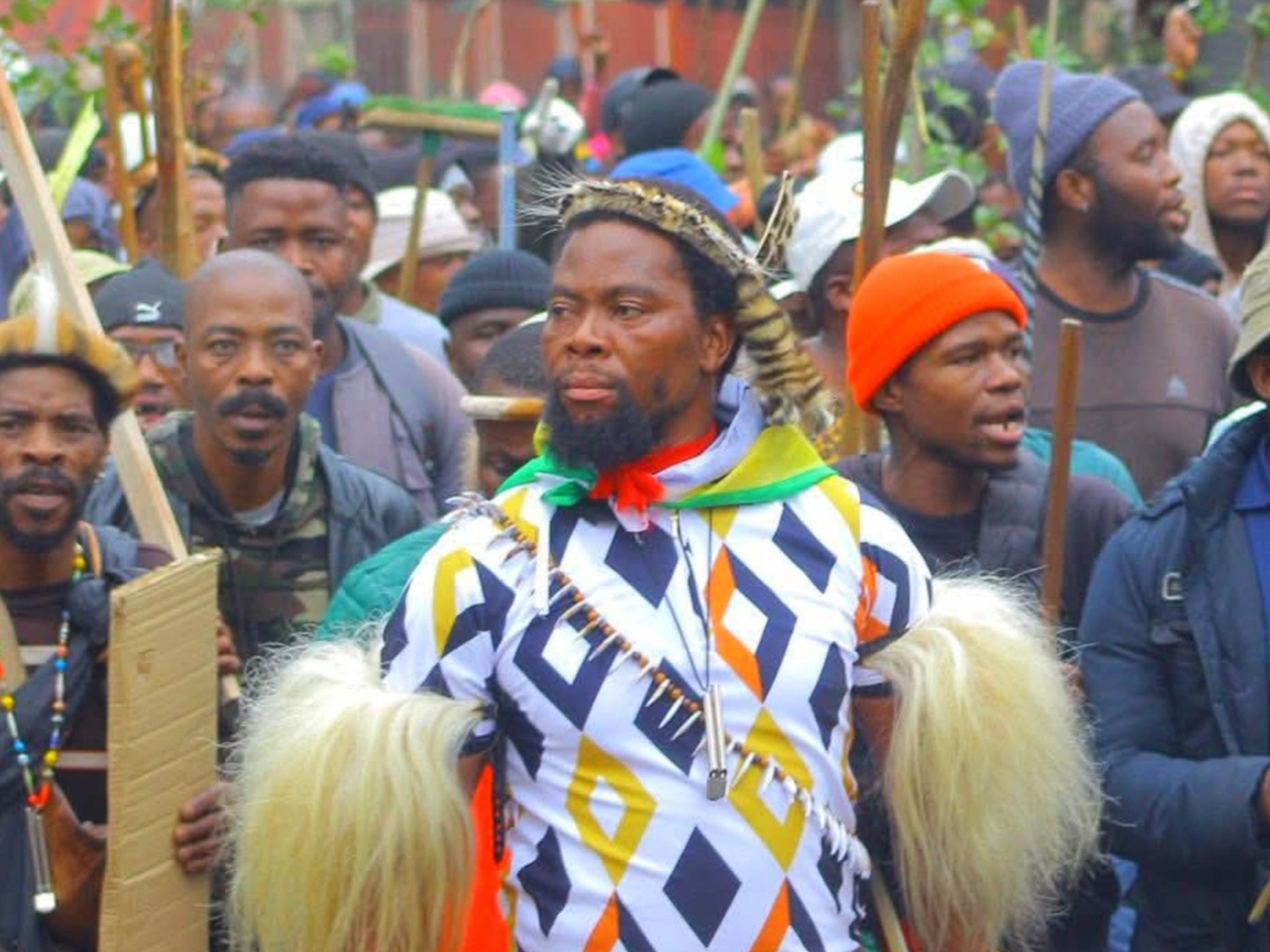
The amabutho are keeping the peace. That should be the state’s job. Thousands of Zulu regiments are marching through South African cities, disciplined and structured, answering to King Misuzulu kaZwelithini. The question is how long that can last, writes Zukile Majova in Real Politics.
South Africa is seeing a rare and powerful sight. Thousands of Zulu regiments are marching in city centres, dressed in full traditional gear and carrying weapons that symbolise a warrior past.
At first glance, it looks like a show of force. The shields, the chants, the tight formations. But there is more going on beneath the surface.
These are amabutho. They are not a random crowd. They are a structured, disciplined force with roots deep in Zulu history. Their chain of command runs up through traditional leaders to King Misuzulu kaZwelithini.
That matters.
Unlike many political marches, which often break into chaos, these formations have shown remarkable control. There have been no widespread reports of looting, burning or clashes with police. In some cases, officers have stood calmly alongside march leaders.
This discipline is not by accident. It is enforced.
Nkosikhona Phakelumthakathi Ndabandaba, who leads many of these marches, has made it clear that violence will not be tolerated. In one widely shared video, he lashes supporters who attacked foreign nationals. His message is simple: the protest must stay peaceful. Inside the ranks, indunas from hostels and townships guide the movement, manage the crowd and make sure instructions are followed.
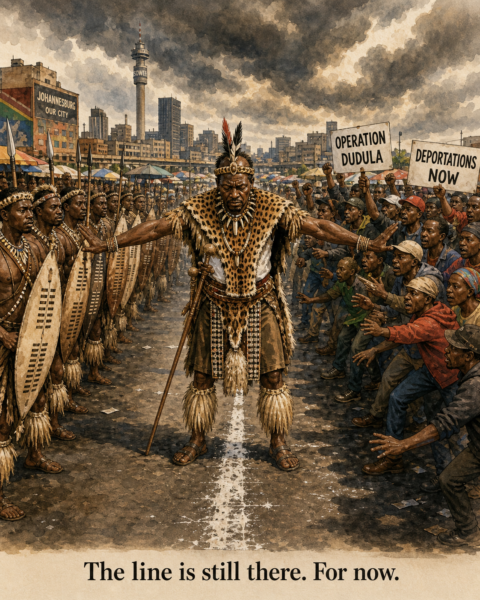
The role of King Misuzulu is central to all of this. The amabutho do not act in a vacuum. Their legitimacy comes from the Zulu royal house. When they move in such large numbers, it signals approval from the top. That link to the king also helps explain why security forces have taken a softer approach. Authorities understand how amabutho operate. They know this is not a loose gathering but a structured system with leadership and rules.
So far, that structure has helped contain violence rather than fuel it.
But the situation is not without risk.
These marches are happening in a country under pressure. Unemployment is high. Many people feel left behind. In townships and informal settlements, competition for work, space and services is intense. Immigration has become a flashpoint in that struggle.
South Africa has laws that allow skilled people to enter the country. But in the informal economy, enforcement is weak. Many businesses operate in grey areas. Documentation is often unclear. This creates frustration among citizens who feel the system is not working for them.
That frustration is now on the streets.
Civic movements and political groups are tapping into it. They call for mass deportations, demand tighter controls and say they are putting South Africans first. Some of these demands are about law enforcement. But the methods used on the ground do not always follow the law.
This is where the danger grows.
The amabutho have, for now, brought order to these protests. But they are not the only actors. Political parties and groups like Operation Dudula are also present, and their approach is often more aggressive. In some cases, protests have shifted from marching to intimidation. Shops are forced to close. Migrants are targeted.
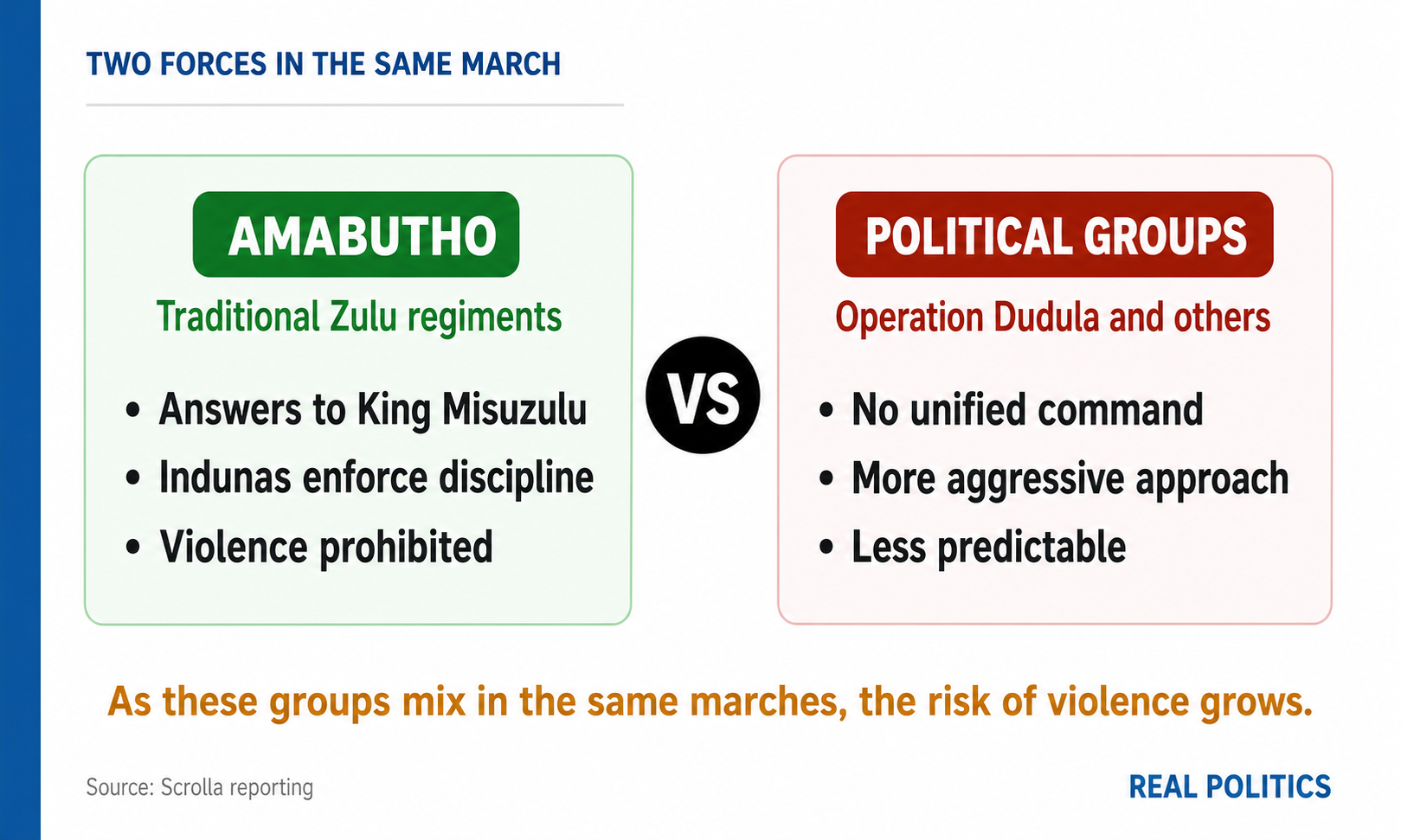
On one side, a highly controlled traditional force that follows leadership and values discipline. On the other, political and civic groups pushing a harder line. As these groups mix, the risk increases. A peaceful march can quickly change if control is lost. It only takes a small group to spark violence — and once that happens, even disciplined formations struggle to contain the chaos.
President Cyril Ramaphosa has tried to strike a balance. He has acknowledged “legitimate concerns” about illegal immigration while warning against xenophobia and attacks on foreign nationals. That balance matters. But it is hard to maintain on the ground.
The deeper issue is the gap left by the state. For years, weak enforcement, poor service delivery and slow systems have created frustration. In that gap, community movements have stepped in. They organise, they mobilise, they act. Sometimes within the law. Sometimes beyond it.
The amabutho marches sit right at the centre of this moment.
They show that large groups can organise without descending into chaos. That discipline and leadership can hold even in tense situations. But they also show how quickly things could shift.
The anger driving these protests is real. It comes from poverty, unemployment and a sense that the system is failing ordinary people. But anger does not always find the right target. It is easier to confront a foreign shopkeeper than to challenge the systems that allow exploitation. It is easier to push out a street trader than to fix broken regulation.
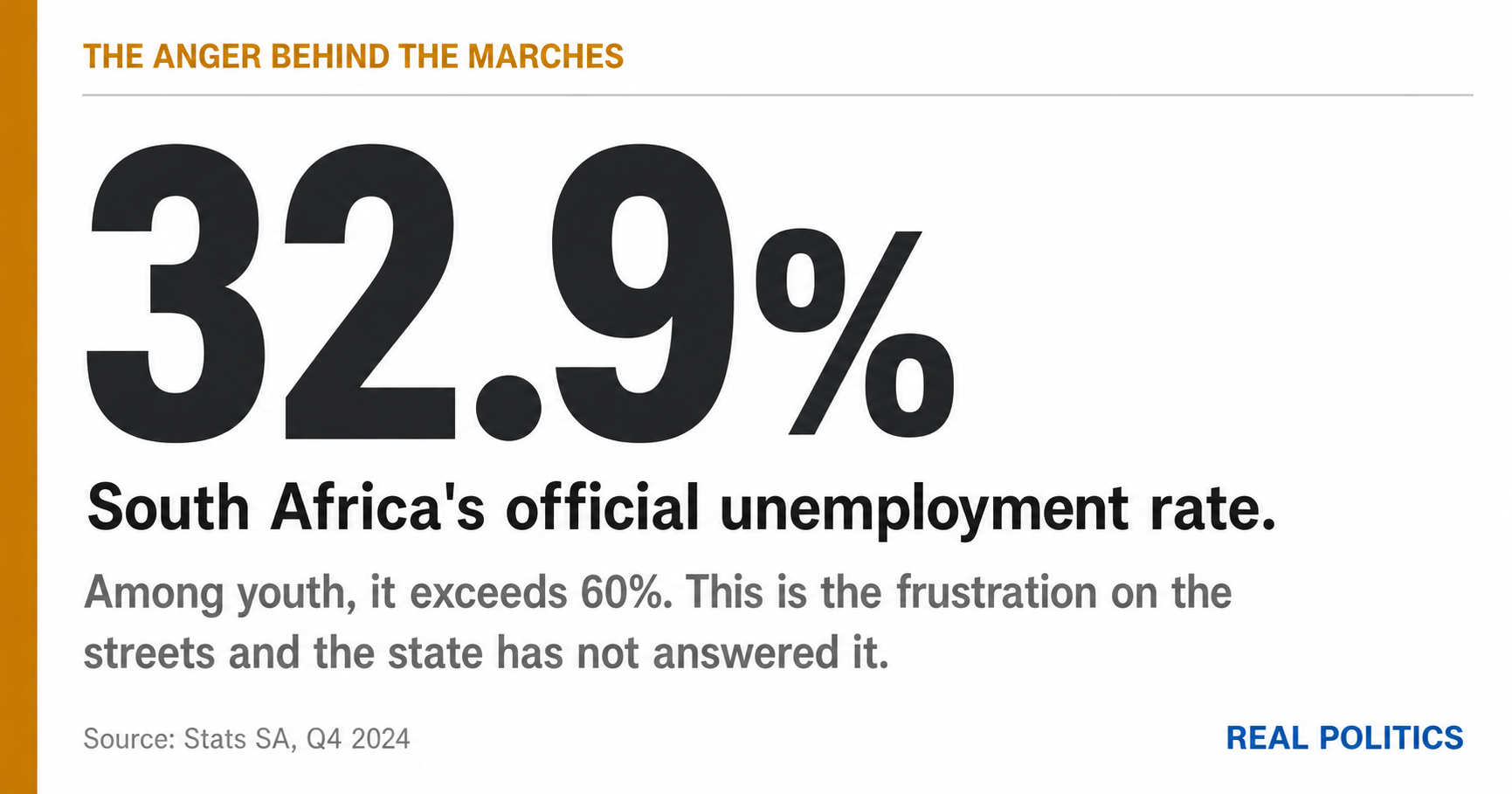
That is how frustration becomes xenophobia.
Once people start deciding who belongs and who does not, outside the law, it becomes very hard to stop. Today it may be migrants. Tomorrow it could be anyone seen as an outsider.
The amabutho have shown restraint. Their link to King Misuzulu and their internal discipline have kept things calm. But the growing involvement of political groups is adding pressure that traditional structures alone cannot absorb.
The line between protest and violence is still visible. But it is getting thinner.
If the state does not step in with clear, consistent enforcement of the law, others will continue to fill the space. And not all of them will choose discipline over chaos.
For now, the amabutho are holding that line. But a line held by others is not a solution. It is a warning.
He and Rob Rose also get into the leadership vacuum in law enforcement that is allowing this to happen, why politicised policing means officers are taking selfies with march leaders instead of stopping them, and what it will take for the state to actually step in. Listen to Sharp Sharp episode five on Spotify and Apple Podcasts now.
Pictured above: The march in Johannesburg.
Image source: Supplied