
By Rorisang Modiba
- South African scientists tested a new underwater sound system in Simon’s Town to quickly send clear pictures through the ocean.
- The drones use sound waves like wireless internet to help people find broken ocean pipes and hidden mines much faster.
Scientists from the Council for Scientific and Industrial Research (CSIR) have built a smart new way for underwater drones to send pictures.
The new system uses sound waves to create an underwater wireless internet connection. This lets the drones send clear pictures to the surface right away.
In the past, people working with underwater drones had two big problems. The pictures taken from far away were often blurry. Also, people had to wait for the drone to come all the way back up to the surface before they could look at the pictures.
The CSIR scientists say their new system fixes both of these problems.
The drones now use a special tool called synthetic aperture sonar to take much better pictures. The clear pictures look like the difference between an old television and a new high-definition screen.
Because the pictures are so clear, it is much easier to see small things hiding under the water. People can use drones to find small leaks in ocean pipes or spot hidden mines.
The team also built a fast underwater internet system that uses sound instead of normal radio waves. Sound travels much better through water.
This means the drones can send their pictures while they are still deep under the ocean. The team said the data moves much faster than older systems.
Scientists have already tested the new technology in the sea in Simon’s Town. They are still working to make it even better.
The drones will help people who work with ocean gas and oil. They will also help scientists who study the sea, people who study history under the sea, and workers checking underwater internet cables.
The CSIR says the new system makes working under the sea faster, safer and much easier.
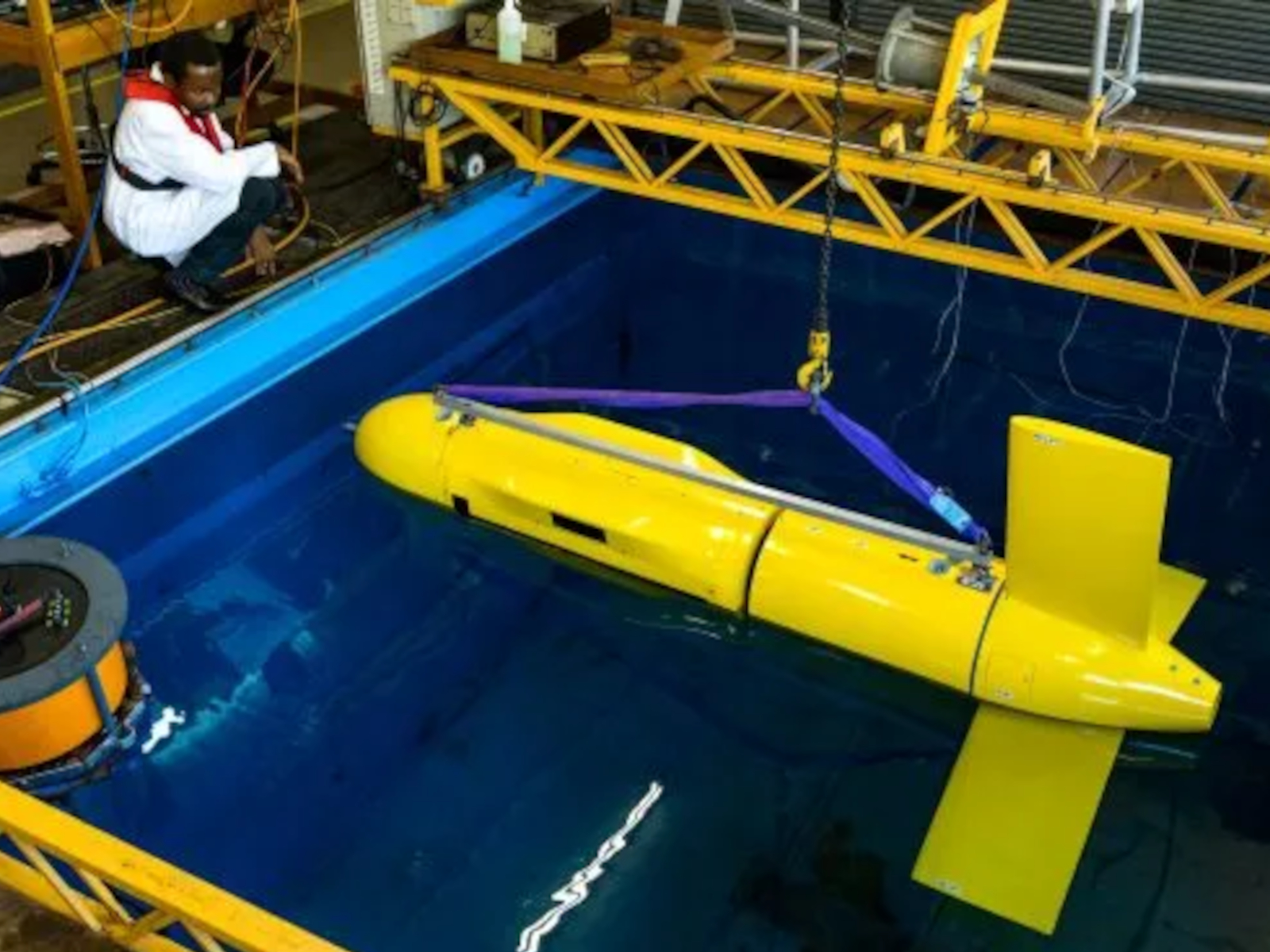
Pictured above: CSIR senior engineer Josiah Jideani lowers a towfish into the water at the CSIR underwater testing facility in Pretoria. His team developed a synthetic aperture sonar system that can be mounted onAUVs or a towed underwater platform (towfish) pulled behind a small boat.
Image source: CSIR