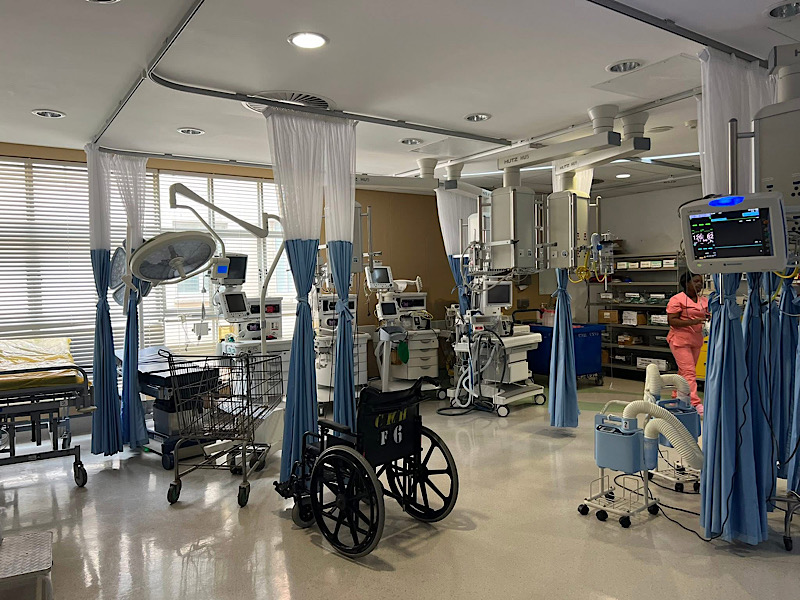
- The Department of Health has placed 36 hospitals on standby and strengthened screening at ports of entry as Ebola cases continue to spread in parts of Africa.
- Health experts say Ebola kills between one-third and half of infected patients but spreads only through direct contact with the bodily fluids of an infected person.
South Africa has stepped up its preparations for a possible Ebola outbreak, even though there are no confirmed cases in the country.
The Department of Health says it is acting out of caution, not panic, as Ebola outbreaks continue in parts of Africa, including the Democratic Republic of Congo and Uganda.
Health Minister Dr Aaron Motsoaledi said the country has already identified 36 hospitals that are ready to isolate and treat suspected Ebola patients if the virus reaches South Africa.
The hospitals include 24 public hospitals and 12 private hospitals spread across the country.
Motsoaledi stressed that South Africans should not panic.
He said Ebola is a dangerous disease with a high death rate, but it is much harder to catch than illnesses such as COVID-19.
“It has a case fatality rate of at least one-third who eventually die. Sometimes it goes as far as 50%, but the good news is that you need very direct contact with a person with Ebola and share bodily fluids with them for you to get it,” he said.
Ebola causes severe fever, weakness, vomiting, diarrhoea and, in some cases, internal and external bleeding.
The virus spreads through direct contact with the blood or other bodily fluids of an infected person or through contaminated objects.
It does not spread through the air like influenza or COVID-19.
To reduce the risk of imported cases, health officials have strengthened screening at South Africa’s ports of entry.
Port health officials working with the Border Management Authority are screening travellers arriving from countries affected by Ebola.
Passengers are checked for symptoms and, if necessary, referred for further medical assessment.
“We have what we call port health workers,” Motsoaledi said.
“These are workers from the Department of Health who have been transferred to the Border Management Authority to conduct screenings and tests for everyone coming into the country.”
The National Institute for Communicable Diseases is also on high alert.
Scientists and laboratory staff have been preparing to safely test and investigate any suspected Ebola cases that may emerge.
Health authorities say early detection is one of the most effective ways to stop the virus from spreading.
Professor Helen Rees from the Wits Reproductive Health Institute said health authorities across Africa are closely monitoring the outbreaks because Ebola can spread quickly if cases are not detected early.
She said the virus spreads through close human contact, including contact with infected patients, contaminated bedding and bodily fluids.
She added that some early infections may also occur during funeral practices where mourners come into contact with the body of someone who has died from Ebola.
Rees said outbreaks are especially difficult to control in conflict areas where healthcare services are limited and medical teams struggle to reach affected communities.
Despite the concern, she said South Africa is not facing an immediate Ebola emergency.
Instead, the country’s health authorities are focusing on surveillance, laboratory readiness and border screening because of regular travel between South Africa and countries where Ebola cases have been reported.
“We do need to think about what sort of surveillance we need to have, and certainly that thinking is ongoing,” she said.
Health officials say the public should remain calm, practise good hygiene and seek medical attention immediately if they develop symptoms after travelling to an affected country or after coming into contact with someone infected with Ebola.
Pictured above: The Department of Health has placed 36 hospitals on standby as South Africa prepares for possible Ebola cases.
Image sourced: Department of Health