
Fighting hunger in Africa needs more than handouts — it needs land, skills, and support for millions to grow their own food, writes Zukile Majova in Real Politics.
Millions of Africans are going to bed hungry — even though their countries are spending billions on social grants.
In South Africa, the government spends over R200-billion a year on grants.
We hand out money, but people are still unable to afford meat, vegetables or eggs. Food prices are too high. There are not enough jobs. And people are trapped in a cycle of poverty.
What if we did something different?
What if the governments gave people land, skills and support to grow their own food?
This is not a dream. It is a real solution that can work — and now is the time to act.
South Africa is preparing to host world leaders for the G20 Summit in November. The theme is “Solidarity, Equality and Sustainability”.
President Cyril Ramaphosa can use this moment to lead a farming revolution that feeds our people and helps fight climate change.
We need to teach people to farm. Not just on big plots, but in townships, schoolyards, rooftops and even pavements. We need to help families grow food, sell food and lift themselves out of hunger.
Minister of Agriculture John Steenhuisen must take the lead. He must launch a national plan to train people in farming, business and entrepreneurship. The government must give access to land, water, seeds and tools.
And existing farmers must be paid to mentor young growers and help them succeed.
This is not about high-tech farming. It’s about smart, simple methods that work with nature, not against it.
One example is the System of Rice Intensification (SRI), a method now used by more than 50,000 farmers across 13 West African countries. It boosts yields by up to 86% while reducing the need for fertilisers and water.
SRI is based on five simple steps:
- Transplanting young seedlings, 8 to 15 days old.
- Planting them further apart to get more sunlight and air.
- Using less water and letting the soil dry before watering again.
- Using compost instead of chemicals.
- Aerating the soil to help roots grow deeper.
These methods do not only work for rice. They can be used for maize, spinach, carrots, tomatoes and more.
And the benefits go beyond food.
Healthy soil traps carbon and fights climate change. Small-scale farming reduces the need for trucks and fuel. It keeps more water in the ground. And it makes people less dependent on food companies and expensive shops.
As Dr Adam Parr from the Downforce Trust puts it, farming can be part of the solution to climate change. “Farmland covers a third of the world’s land,” he says. “If we farm it right, it can absorb carbon and store it.”
That’s why we need a food system that is local, low-cost and sustainable. One that cannot be broken by floods, drought or wars in faraway countries.
We must stop relying on giant food companies who control what we eat and how much we pay.
Let’s be honest: social grants help people survive — but they also keep them dependent. That is not real freedom.
Instead of increasing grants every year, we must invest in helping people grow food and create small businesses.
Imagine if a portion of the grant budget was used to train new farmers, build water tanks, and supply seedlings.
Imagine if thousands of school feeding schemes bought vegetables directly from community gardens.
Imagine if our people were not lining up at paypoints — but at markets to sell their crops.
This is not only possible. It is urgent.
The cost of food is rising fast. Many families now eat eggs for dinner — not breakfast. Tinned fish is the last affordable source of protein. Even vegetables are too expensive for some.
This cannot be the future we leave to our children.
Last week, President Ramaphosa said food security is one of the goals of the Government of National Unity. He praised the School Nutrition Programme for feeding over nine million learners daily.
That is a good start. But feeding people is not enough.
We must help them feed themselves.
We must build a country where every backyard can be a food garden. Where children learn to grow vegetables at school. Where the unemployed become smallholder farmers and feed whole communities.
Minister Ramokgopa is leading a shift to clean energy. Now we need the same boldness from Minister Steenhuisen to shift agriculture in a new direction.
We need farming training centres in every province. We need land to be made available. We need tools, water, and support.
And we need markets where small farmers can sell their produce at fair prices.
This will reduce reliance on grants. It will create jobs in farming, food processing and delivery. It will bring dignity, health and pride back to our communities.
President Ramaphosa has praised Shoprite for selling R5 meals. But that is not a solution. It’s part of a broken system where poor people depend on big businesses to survive.
The real solution is in the soil.
Let’s turn our energy and money into helping people grow food. Let’s create food gardens, not food queues.
Let’s grow hope. Let’s grow freedom. Let’s grow food.
This is why I am proud of Scrolla’s climate media awards (https://climateawards.africa/)
This year we launched a new agriculture category, sponsored by SRI-2030 — because farming is one of the best tools we have to fight hunger and climate change.
One way to win the award is to make a powerful call to action.
This article is my way of making such a call.
Let the South African government lead a farming revolution that feeds our people and saves our planet.
Let’s teach millions to fish — or better yet, to farm.
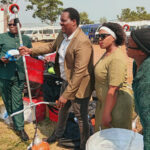
Pictured above: Agriculture Minister John Steenhuisen.
Image source: @jsteenhuisen