- Olona Jongile, 27, works as a security guard and does washing, and relies on a child grant, but food still runs out.
- The Cape Town food basket costs R5,298 a month, more than nine times the R580 child grant Jongile relies on.
Olona Jongile works two jobs. She guards a school during holidays and washes other people’s clothes. She also receives her son’s child support grant. She is 27 years old, supports five people, and last Monday her family ate bread and coffee because there was nothing else.
By Wednesday, the electricity was gone too. She had R50 left and spent it on a prepaid top-up.
“I bought electricity for R50 and I am now broke,” she said.
Her mother called relatives for help. The family ate rice, pilchards and samp throughout the week, some of it brought home from the school where Jongile works. Her five-year-old son never went without. A neighbour fed him on the days the house had nothing.
Her five-year-old son did not go hungry. A neighbour fed him on the days the house had nothing.
“On some days when we don’t have food, I have a neighbour who dishes up for my son. So at least I know that while we try to get food, he is not hungry,” Jongile said.
Jongile lives close enough to the school to walk, which means she pays no transport. She does not pay rent. Those two things are the difference between her situation and something worse.
The Cape Town food basket costs R5,298.04 in June 2026, according to the Pietermaritzburg Economic Justice and Dignity Group. The child support grant is R580.
Sibusiso Mboto, Advocacy Coordinator at PMBEJD, said families in this position cut protein and vegetables first, keeping maize meal, flour, rice, and sugar because those are the foods that last the month.
“When families cut down on protein and vegetables, such choices have long-term negative effects on children, including stunting,” Mboto said.
Registered dietitian Cari Erasmus said a diet built mainly on rice, samp, mealie meal, and pilchards meets energy needs but creates a high risk of micronutrient deficiency.
“Without regular fruit and vegetables, the diet is likely to fall below the requirement for key micronutrients like vitamin A, C, potassium, iron, iodine, and fibre,” Erasmus said.
Jongile did not know the City of Cape Town runs an indigent assistance programme for households earning below R7,500 a month, one she qualifies for. When Scrolla told her, she was happy, but guarded.
“I’ll believe it when I receive it,” she said.
Residents in Jongile’s situation can apply at [email protected]. For pensioner rebates, the address is [email protected].
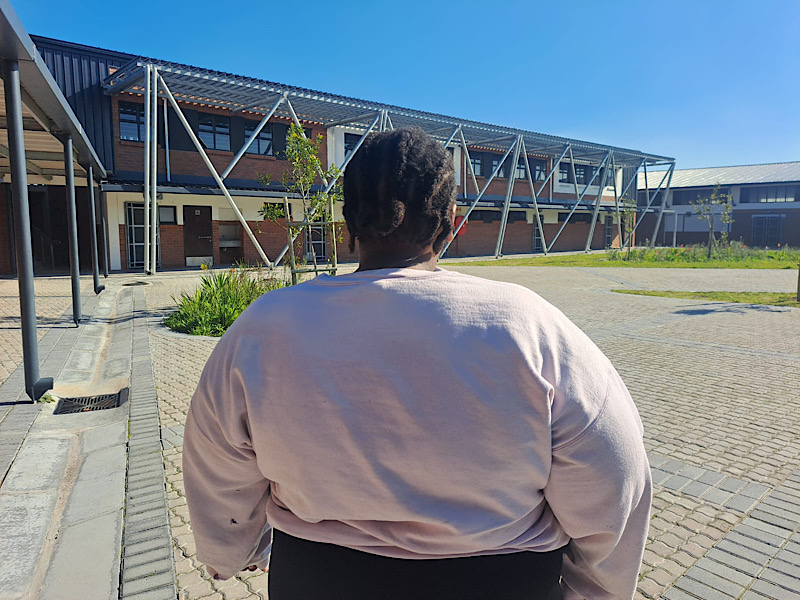
Pictured above: Olona Jongile at Lower Crossroads High School in Cape Town, where she works as a security guard during school holidays.
Image source: Buziwe Nocuze