Listen to this article.
By Anita Dangazele
- The Department of Mineral and Petroleum Resources confirmed petrol will rise by 20 cents a litre and diesel by up to 65 cents from 4 March 2026.
- Political leaders say conflict involving the United States, Israel and Iran could push oil above 110 dollars a barrel and damage South Africa’s fragile economy.
South Africans will pay more at the pump from Wednesday as global tensions spill into local pockets.
Petrol will go up by 20 cents a litre for both 93 and 95 grades. Diesel will jump by 62 cents a litre for 0.05 percent sulphur and 65 cents for 0.005 percent sulphur.
Wholesale illuminating paraffin will increase by 44 cents a litre. The single maximum national retail price for illuminating paraffin will rise by 58 cents a litre. The maximum retail price of liquefied petroleum gas will go up by 23 cents a kilogram nationally and by 26 cents a kilogram in the Western Cape.
The Department of Mineral and Petroleum Resources said the hikes are based on current local and international factors. The changes take effect on 4 March 2026.
The department said the average Brent crude oil price increased from 64.08 dollars a barrel to 69.08 dollars during the period under review. Higher shipping rates and growing tension between the United States and Iran were key reasons.
On 28 February, the United States and Israel launched attacks on Iran. Iran responded by striking United States military bases in the Middle East. Shipping near the Strait of Hormuz then slowed sharply.
Reuters reported on 2 March that about 150 ships were stranded in the area. Nearly one fifth of the world’s oil passes through that narrow route.
Chairperson of Parliament’s Standing Committee on Finance Dr Joe Maswanganyi said the conflict will hit South Africa’s budget hard.
“We condemn the violations of international law because this conflict is going to have a serious impact on our budget that has been tabled last week,” Maswanganyi said.
He said South Africa cannot ignore events abroad because they directly affect trade and the local economy.
Songezo Zibi, national leader of Rise Mzansi, also criticised the attacks.
“Therefore, this attack by the United States and Israel on Iran is unlawful in terms of international law,” Zibi said.
Economists warn that if the conflict worsens and oil climbs towards 110 dollars a barrel, fuel and food prices could surge. Inflation, which cooled to 3.5 percent in January, may rise again.
Frederick Mitchell, chief economist at Aluma Capital, warned that the recent relief from high inflation may be short lived.
“Higher international oil prices, combined with a depreciating rand, will exert massive upward pressure on the domestic fuel price,” Mitchell said.
He said the South African Reserve Bank may have to keep the repo rate at 6.75 percent, leaving consumers with higher debt costs as living expenses rise.
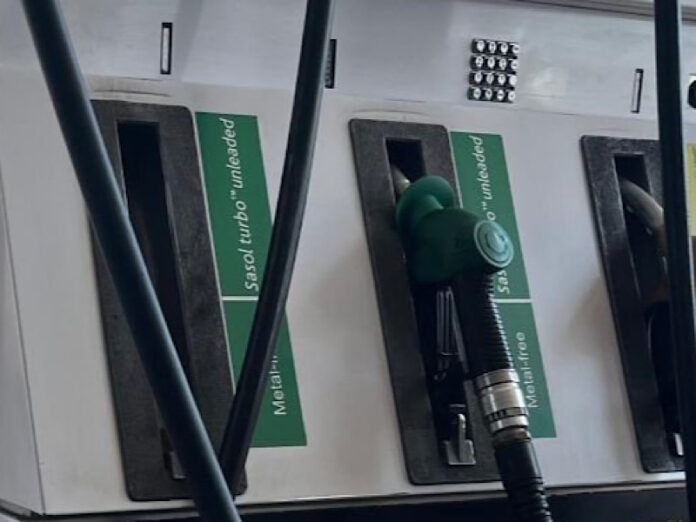
Pictured above: Motorists will pay more for petrol and diesel from 4 March 2026.
Image source: