- All 27 Limpopo municipalities used financial reporting consultants in 2024/25, spending R235.85-million on top of R885.01-million spent on their finance units.
- Despite the huge consultant bill, 20 municipalities submitted financial statements with serious errors in areas where consultants had been brought in to help.
Limpopo municipalities spent more than R235-million on financial consultants in just one year, but serious mistakes still ended up in their books.
Now the Democratic Alliance wants those responsible to pay the price.
The party has called on Limpopo’s Department of Cooperative Governance, Human Settlements and Traditional Affairs to enforce penalty clauses against service providers where consultants failed to deliver acceptable work.
The demand follows concerns raised by Auditor-General Tsakani Maluleke over municipalities’ heavy reliance on outside consultants during the 2024/25 financial year.
According to the Consolidated General Report on Local Government Audit Outcomes for 2024/25, all 27 municipalities in Limpopo used consultants to help with financial reporting.
Together, they spent R235.85-million.
But despite that bill, 20 municipalities, or 74%, submitted financial statements containing material misstatements in areas where consultants had worked.
The Auditor-General found that the quality of financial statements remained poor and municipal finance units did not properly check the work done by consultants.
Some municipalities spent millions.
Mogalakwena Local Municipality spent R31.48-million, while Polokwane Municipality spent R26.62-million.
Fetakgomo Tubatse Local Municipality spent R22.51-million and Thabazimbi Local Municipality spent R19.38-million.
Collins Chabane Local Municipality spent R17.25-million, Modimolle Mookgophong Local Municipality spent R16.5-million and Maruleng Local Municipality spent R11.75-million.
And the consultants were not the only cost to taxpayers.
Democratic Alliance Member of Parliament Jacques Smalle said municipalities spent another R885.01-million on their own finance units.
This means taxpayers were paying municipal finance staff while municipalities were also spending hundreds of millions of rand on outside experts.
The Democratic Alliance now wants a skills audit conducted across municipal finance units to find out where staff lack the necessary skills.
“The AG cited poor financial reporting, driven by a lack of skills in the finance units, weak in-year controls, poor record-keeping and a lack of consequence management, resulting in recurring errors as reasons for the chronic underperformance,” Smalle said.
He questioned what municipalities were getting for the money spent.
“While spending on consultants remains stubbornly high, questions remain about the real value for money and the lack of capacity of consultants.”
The problem stretches far beyond Limpopo.
According to the Auditor-General’s national report released in June, 225 municipalities across South Africa spent R1.61-billion on financial reporting consultants in 2024/25.
A decade earlier, 179 municipalities spent R590-million.
The report said municipalities mainly hired consultants because they lacked skilled employees, had vacant positions or faced both problems.
A lack of skills accounted for 53% of appointments. A combination of vacancies and skills shortages accounted for 41%, while vacancies alone accounted for 6%.
The Auditor-General also found that some consultants were repeatedly appointed, with a limited number of service providers working across several municipalities and services over successive years.
The wider picture of municipal finances is also worrying.
Only 35% of municipalities nationally were assessed as having good financial health.
Another 40% were considered concerning, while 25% were assessed as unfavourable.
The Free State, Mpumalanga and North West had the highest number of municipalities facing financial distress.
Eleven municipalities operated with unfunded budgets, while another five reported deficits.
The Democratic Alliance argues that municipalities should be building strong finance departments instead of repeatedly spending taxpayers’ money on consultants.
“A vote for the DA is a vote to end cadre deployment in local government, appoint qualified professionals on merit, and rebuild municipal finance units so that residents get value for money and municipalities stop relying on costly consultants to perform functions that should exist in-house,” the party said.
For Limpopo taxpayers, the numbers leave a simple but uncomfortable question: after spending R235.85-million on financial experts, why were serious mistakes still being made?
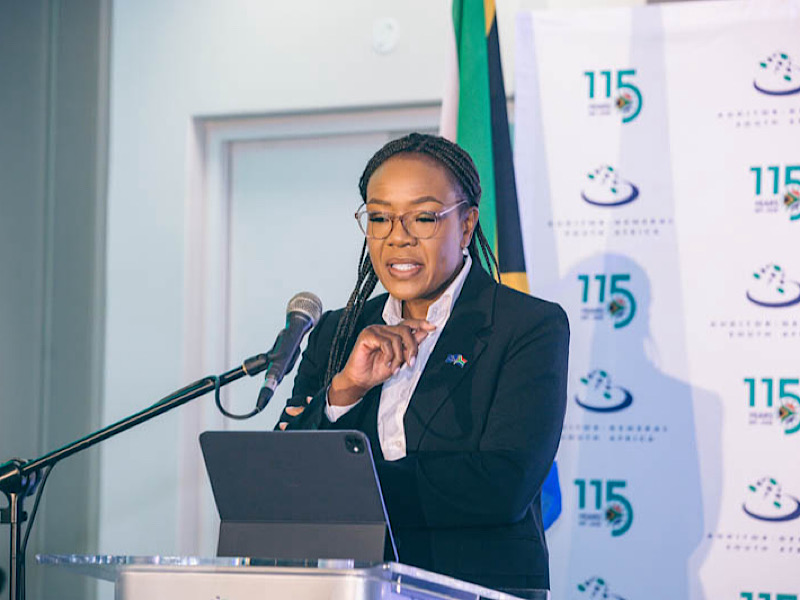
Pictured above: Auditor-General Tsakani Maluleke, whose report raised concerns about municipalities’ continued reliance on financial consultants.
Image source: Supplied