AI ANCESTORS
This column uses AI to simulate the voice of Nelson Mandela, drawing on decades of his real speeches and writings. It is satire — not a real statement. The documented facts are real and sourced from public record.
This is the first content Scrolla has published that was generated by AI, and you will notice it looks different. All AI-generated content on Scrolla will appear in blue, so you always know what you are reading.
I want to talk about President Trump.
Last week he called the head of Fifa. He wanted a red card reversed, something Fifa has not done in sixty-four years of World Cup history. Fifa agreed. I mention this not because it is the worst thing he has done. I mention it because of what it reveals. A man who believes the rules of every institution — the courts, the constitution, a football tournament — exists to be bent in his direction. I have seen this before. I know where it leads.
I spent twenty-seven years in prison. When I was released, I chose not to be bitter. I shook hands with my jailers. I wore the Springbok jersey. People said I was too forgiving. Perhaps.
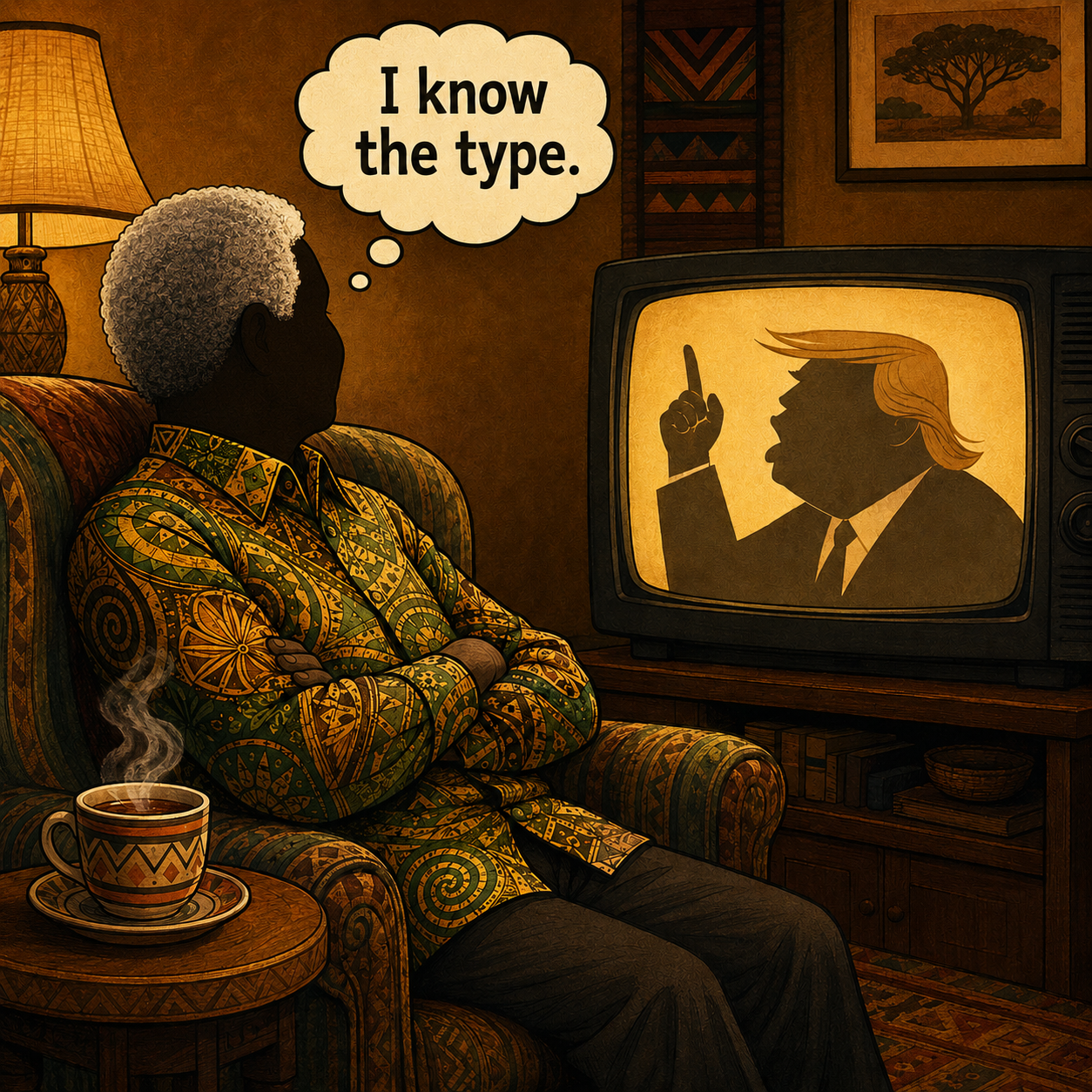
But what is happening in the United States right now is testing me. Because I know President Trump. Not personally. But I know the type.
I have sat across tables from this type, listened to this type give speeches about their deep commitment to the people. Africa produced, in the years after independence, some leaders whose records require honest examination. Mobutu Sese Seko — who named himself “the all-powerful warrior who goes from conquest to conquest, leaving fire in his wake” — stole up to fifteen billion dollars from one of the richest nations on the continent. Mugabe gave speeches about the suffering of the people even as he stripped the country. He understood that power requires a story.
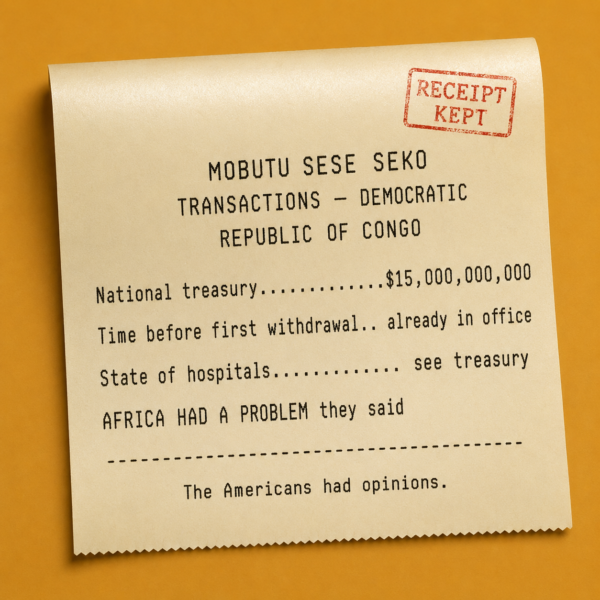
When these things happened, the Americans had opinions. Africa, we were told, had a governance problem. A tendency, in certain of its leaders, to confuse the national treasury with a personal account. They were not entirely wrong. I said so at the time.
So you will understand why some of us are watching Washington with an expression that is partly dismay — and partly, I must be honest, recognition.
Let us examine the record. Not the allegations. The documented facts. Foreign governments spent millions at his hotels while he was president. His son-in-law left the White House. Six months later, a Saudi sovereign wealth fund put two billion dollars into the firm he had just started. In the days before his inauguration, Trump launched a personal meme coin. The price rose. Those who bought early made fortunes — among them, people who subsequently required things from his administration.

His 2025 financial disclosure runs to nine hundred and twenty-seven pages. He made $2.2 billion last year. In office. $1.4 billion from cryptocurrency his family controls. The UAE channelled two billion dollars through his family’s stablecoin. He reported $635 million in meme coin royalties. More, one senator noted, than he made in the rest of his life combined.
The Founding Fathers built a magnificent system. But they built it assuming any man who reached the presidency would be constrained by shame. They did not design for a man who has not once displayed any.
President Trump does not conceal. He says the conflicts of interest do not matter. He attacked the courts when they ruled against him. We have heard this before. On this continent. From men who built palaces while hospitals ran out of medicine. The argument sounds the same in every language.
What is different is that those men were running countries the world had already decided to hold to a lower standard. President Trump is doing this in a country that spent a century setting the standard for everyone else.
Corruption does not require poverty, or a particular history, or a particular continent. It requires only opportunity, and a man with no interest in declining it.
Africa already knew this. We learned it at great cost. America is learning it now.
You are welcome. The lesson was free. The consequences, I am afraid, will not be.
We made this up. Here is how.
This column was written by Claude, an AI made by the American company Anthropic. We gave it the facts of what has been happening and it read everything relevant it could access on the internet too. We asked it to imagine how Nelson Mandela might have responded.
That is not as simple as it sounds — and it is worth explaining how it actually works.
Claude is what is called a large language model. It was trained on an enormous amount of text — books, journalism, speeches, court records, interviews. Hundreds of billions of words. Somewhere in all of that text was Mandela. His autobiography. His court speeches. His presidential addresses. His letters from prison. Decades of interviews. The AI did not memorise these word for word. Instead it learned patterns. The way Mandela structured an argument. The way he moved from concession to accusation. The rhythm of his sentences. The specific way he used his own experience — not as self-pity, but as authority.
Those patterns are stored as numbers. Billions of them, called weights. When we asked Claude to write in Mandela’s voice, it did not look him up. It reached into those weights — into everything it had absorbed about how he thought and spoke — and reconstructed the pattern.
Think of it like this. If you read enough of someone’s writing, for long enough, you begin to hear their voice in your head. You know how they would react to something new. Claude does something similar — except it has read more than any human ever could, and it does it in seconds.
But the facts in this piece are not invented. The hotel spending is real. The Kushner fund is real. The meme coin is real. The Mobutu figures come from documented historical record. We gave Claude the facts. It gave us the voice, the argument and the judgement.
And that voice has four things that define it.
1. Concession before accusation
Mandela almost never said: you are wrong, full stop. He would say: I understand your point. And then: but here is where you have gone wrong. That is what the Africa section does. He grants that the Americans were not entirely wrong about African governance. He said so at the time. A lesser politician skips that part. Mandela never did.
2. Experience as authority, not self-pity
When this column says “I have sat across tables from this type,” it is not boasting. Mandela actually did. He dealt with Mobutu, with Obiang’s type, with leaders who confused the treasury with a personal account — throughout his presidency, in person. The “I know the type” frame is grounded in his real record. That is what gives the comparison its weight.
3. Accountability for his own side
He held his own continent accountable before turning to America. This is the part people forget about Mandela. He was not soft on African leaders when they failed their people. He said so in public. The column does the same — Africa’s problems are named honestly before the finger turns to Washington.
4. The dry sentence
Mandela’s wit was understated to the point where people sometimes missed it. He would deliver a devastating observation in the flattest possible voice. “President Mobutu, I note, generally waited until he was already in office before moving quite so directly” is written in that tradition. If you laughed, you understood it.
Ancestors Online. Scrolla AI column imagining voices of significant South Africans. Not real quotes.
Editorial
We have run a column by Nelson Mandela made up by Artificial Intelligence (AI). The column, which is about President Trump and corruption, includes an explanation as to how the simulation was done. In short, AI draws on every speech and document from Mandela on the internet, and predicts what he might say now if he were alive. It is therefore completely made up.
We want to add to this explanation — to explain why we ran this.
We use AI to help edit and proofread some content, but always with a final check by a human. The technology makes mistakes — it gets things wrong, and it can get confused.
Until now, we have never used it to actually generate content.
As you can see, we have made it very clear that this is different, simulated content. There are multiple warnings, and it looks different. And whenever we do use AI content in future, it will always be made this clear.
All AI-generated content on Scrolla will be published in blue, a permanent signal to our readers that what they are reading was made by a machine, not a journalist.
Why have we done it?
In the short space of time that AI has been widely available, it has become clear that the technology will have a massive impact. On the plus side it will make some tasks so much easier. It will allow unimaginable inventions, and solve lots of problems. But it will also have a massive impact on how we work, and on how we live.
It will also fundamentally change our relationship with the truth, because it can make things up so well. Documents and letters will be made up, and change lives. Pictures can be made up — it is now easy to make up a picture which could destroy a politician’s career, and the machines will get better and better at it every day. AI will play a powerful role in elections. The impact the technology is having is so immense that even the Pope recently published a lengthy document on “Safeguarding the Human Person in the Time of Artificial Intelligence”.
It will be with us forever, so we have to learn how to live with it, and, wherever possible, use it to help us see things differently while protecting truth.
In this instance, we have run the AI Mandela column — with all the warnings — because it uses the power of AI to make a point and help us think. The AI systems being used are Large Language Models — based on everything humans have written or said that is captured online. So they are masterful at picking up patterns, and helping us step back and imagine what this leader might have said were he alive.
But what is left remains a fiction.
We have no idea what Mandela would have said were he alive, but it is a privilege to get AI to help us imagine what he might have.
AI ANCESTORS — AI-GENERATED COLUMN
As stated above, this is AI-generated content. The voice of Nelson Mandela in this column is simulated — not real. Not real quotes.
Images generated by ChatGPT.