
Listen to this article.
- The Pietermaritzburg Economic Justice and Dignity Group tracks food prices monthly across seven South African cities, including Johannesburg, Durban and Cape Town.
- Nearly half the household food basket is made up of VAT-liable foods, and that portion has risen 6% in the past year alone.
Every month, a low-income family of seven pays R350,21 in VAT on their groceries. A 30kg bag of maize meal costs R302,68. The tax costs more than the staple.
That is one of the findings in the May 2026 Household Affordability Index, released by the Pietermaritzburg Economic Justice and Dignity Group (PMBEJD), which tracks food prices across seven cities every month. The index is built on data collected by women living on low incomes in those areas, shopping at the same supermarkets and butcheries their communities use.
The average household food basket for a family of seven cost R5,479.26 in May 2026. Of the 44 foods tracked, 22 are subject to VAT. Those foods make up 49% of the total basket cost.
The VAT on those foods came to R350,21. That is 6,4% of the entire basket.
And it is rising. The VAT-liable portion of the basket has increased 6% year-on-year, far faster than the basket overall, which grew just 0,2%.
If that R350,21 were returned to the family every month, it would cover their entire maize meal supply and still leave enough for a bag of salt and two tins of soup. Or it would pay for rice, potatoes, samp and cabbage combined.
These are not luxury foods. They are the base of every low-income meal in South Africa.
The PMBEJD data already shows that families living on low incomes underspend on basic nutritional food by at least 17% every month. That gap, between what they buy and what their bodies need, sits at R1,154,96.
The VAT they pay on food every month is nearly a third of that shortfall.
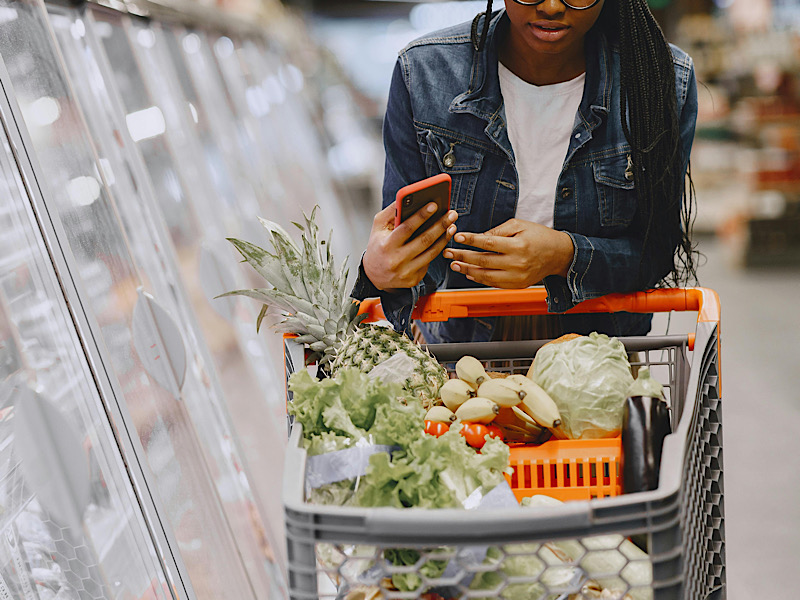
Pictured above: A woman shopping at a supermarket.
Image source: Pexels