
Listen to this article.
- Education costs are rising by around 9% to 10% a year, meaning parents could see fees double every seven or eight years.
- Saving R1,000 a month from a child’s birth could grow to R300,000 by the time they finish school, says Warren Ingram.
Giving your child a good education can cost a lot of money.
And the longer parents wait to start saving, the harder it can become to pay the bills.
Education costs in South Africa are rising quickly. For every R100 parents spend on education now, they could be paying about R109 to R110 for the same thing a year later.
Financial planner Warren Ingram says school fees could double every seven or eight years if costs continue rising at this pace.
So a school that is affordable today could become much more expensive as your child gets older.
And school fees are not the only expense.
Parents also need money for uniforms, textbooks, sport, school trips, aftercare and transport.
Ingram says these extras can add another R20 to R30 for every R100 charged in school fees.
For example, imagine you have a five-year-old and their school costs R80,000 a year today.
If fees keep rising at the same pace, the school could cost around R150,000 a year by the time the child reaches high school.
University brings another big bill.
The fees may sometimes be cheaper than private school fees, but students may also need money for accommodation, food, transport and other daily expenses.
Ingram says one of the best things parents can do is start saving while their children are still young.
For example, if you save R1,000 every month from the day your child is born, the money could grow to about R300,000 by the time they finish school, depending on how the investment performs.
But if you wait until your child reaches Grade 6 before saving the same R1,000 a month, you could end up with much less.
Your money simply has less time to grow.
“The earlier you begin, the more the growth does the work and the less has to come out of your own pocket,” Ingram said.
Parents should also think about when they will need the money.
If you will need it for school fees in the next year or two, Ingram says it should be kept somewhere safe and easy to access, such as a money market fund or fixed deposit.
If your child is still young and you are saving for high school or university, you have more time.
Ingram says parents can consider investments such as a low cost unit trust or exchange traded fund.
These investments can go up and down in value, but having five years or longer gives the money more time to recover when markets fall.
Parents should also be careful about taking money away from their retirement savings to pay school fees.
Many parents want to give their children the best education they can afford, but Ingram warns that they should not destroy their own financial future to do it.
Students may be able to get bursaries or student loans. They can also work part time to help pay for their studies.
Parents do not have those same options when they retire.
If they reach retirement without enough savings, their children may eventually have to support them.
The simple message is: start saving for your child’s education as early as you can.
Even if you cannot save a lot, putting away a smaller amount every month while your child is young gives that money more time to grow.
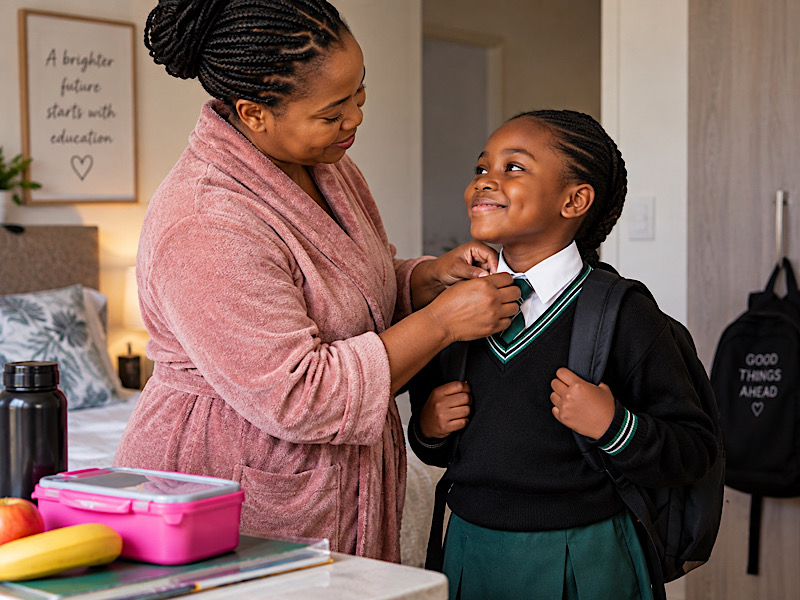
Pictured above: A parent and child preparing for school.
Image source: Pexels