
My Eastern Cape fields used to bloom with daisies and butterflies. Now, climate change and careless farming have turned the hills grey and dry, writes Zukile Majova in Real Politics.
When I was growing up in KwaBhaca in the Eastern Cape, spring came with a clear message. The fields exploded into colour. Hills rolled with wildflowers and butterflies danced over grazing cattle.
The brightest were the orange daisies and yellow dimorphotheca that covered the grasslands. They came every year like clockwork, painting the land with life. But now they are gone.
The land where I used to herd my family’s cattle is bare. The butterflies are gone. The flowers no longer bloom. My children have never seen the beauty I grew up with.
What happened?
For one, it now snows in September. That never used to happen. But this is no longer unusual. Weird weather is here to stay.
And I also blame the way we farm. For decades we’ve relied on fertilisers and cow dung to boost our crops. But this has poisoned the soil. Fertiliser destroys the soil’s pH balance, and when it rains, it runs into the rivers, ruining everything in its path.
Farming one hectare today costs about R6,000. Most people living on communal land are told they can’t afford that. So the fields lie empty, even though they could feed entire families.
It’s not true that farming must be expensive. Across Africa, people are being taught better ways. Organic, climate-friendly farming that costs less and produces more. But here, the knowledge is not reaching those who need it most.
The chiefs and traditional leaders who manage communal land see this. Their people are hungry, but the land stays unused. Farming is seen as something only rich people or big companies do.
That is why we need to change how we talk about farming and climate change.
It must not be a conversation only for scientists, activists and politicians in boardrooms. This is a crisis that affects real people — especially the poor.
That is why I’m calling on all environmental activists, writers, journalists and farmers to enter the climate media awards, now in their second year. The application form is here: https://climateawards.africa
This year, the awards include a new agriculture category. And they’re now open to the rest of the continent — because climate change knows no borders.
I am particularly excited about the agri award because it is one of the key ways in which ordinary people can have an immediate and direct impact on tackling climate change.
And it comes with two bonuses; it’s cheaper and you get better food production out of it.
The Downforce Trust, whose sister organisation SRI-2030 is sponsoring the agri component of the awards, says agriculture, food and land make up 25% of the world’s main sources of greenhouse gas emissions. As the founder of the Downforce Trust, Dr Adam Parr, puts it: “Agriculture is also a huge part of the solution. Healthy soils naturally absorb carbon out of the atmosphere. Farmland covers a third of the world’s land. Put that together and we have a truly scalable, free and proven way to capture and store carbon. And, as SRI-2030 shows, this can be done at the same time as increasing yields and returns for farmers.”
We need the voices of rural farmers, of street vendors, of shack dwellers. We must flip the script. Stop talking down. Let the people speak.
Because while the debates drag on, the damage is real.
Nearly 100 people died in the floods in Mthatha. Homes were drowned by water that rose to the rooftops. Some of these areas had never flooded before.
KwaZulu-Natal and Mpumalanga have had terrifying tornadoes. Heavy storms are no longer once-in-a-decade events — they’re regular. And they destroy everything.
More than R5 billion has already been raised to deal with the Mthatha disaster. But money doesn’t bring back lives. It doesn’t bring back butterflies. And it certainly won’t bring back soil that has been stripped and poisoned.
The United Nations Secretary General António Guterres put it best when he said: “Preventing irreversible climate disruption is the race of our lives and for our lives. It is a race we can – and must – win.”
He is right. But we cannot win that race without the farmers, the land custodians, the poor, the forgotten — those who live with the daily impact of climate change.
Yes, I understand the country is drowning in crises — inequality, rising crime, a shaky government of national unity, and the challenges of artificial intelligence.
But if we don’t act now on the climate and responsible farming, things will get worse for the next generation. Much worse.
I will not criticise President Cyril Ramaphosa here. He is serious about climate change. His R1.5 trillion Just Energy Transition plan is a bold attempt to shift South Africa away from fossil fuels.
But we need more than that.
I want Agriculture Minister John Steenhuisen to take the lead on this. His Democratic Alliance is the second biggest partner in government. He has a history of grassroots activism. He understands communities.
He also understands land. And he wants it to be productive. That’s the key. If he can lead a shift towards responsible, sustainable farming, we could start a new farming revolution in this country.
Imagine thousands of rural families turning fallow land into food gardens — without fertilisers, without debt, and without destroying the soil.
Imagine a generation of children growing up on healthy land again, able to spot butterflies and smell daisies in spring.
That is why I support the climate media awards. That is why I will keep writing about farming, climate and the environment in the months to come.
Because this is personal.
This is where my passions meet: politics, farming and the environment.
And it starts with a simple truth: if we do not change the way we farm, if we do not listen to the land, we will lose it. Forever.
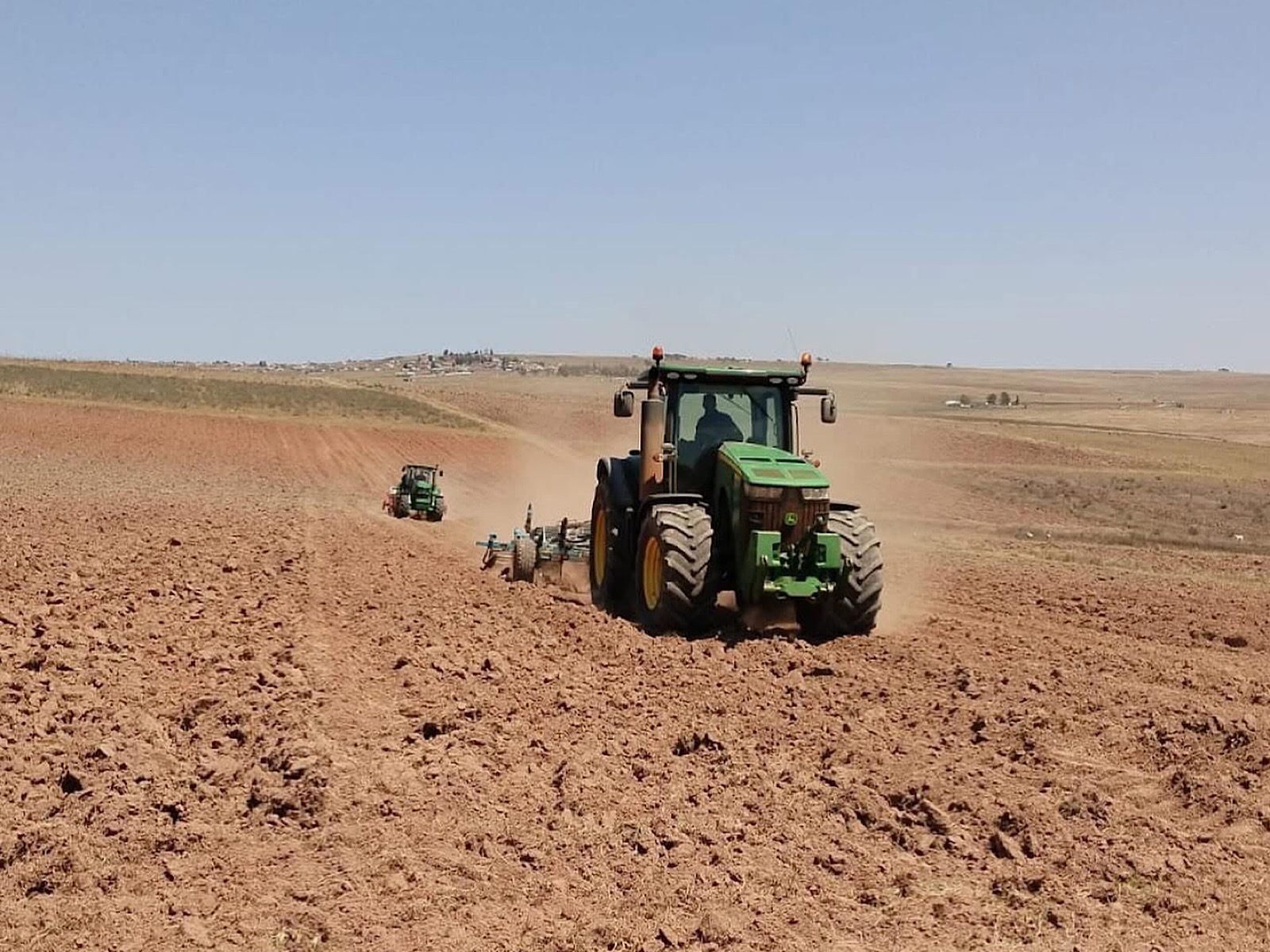
Pictured above: A tractor ploughing through a patch of land in the Eastern Cape.
Image source: Eastern Cape Department of Agriculture