
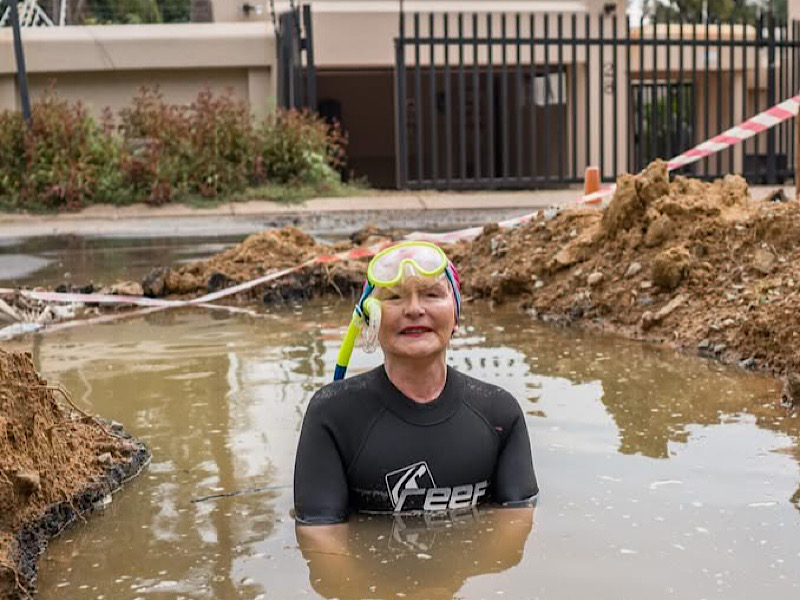
Helen Zille is running a smart campaign for mayor of Johannesburg because she refuses to turn the election into an ideological fight, writes Zukile Majova in Real Politics.
When asked about the Democratic Alliance’s position on Israel and Gaza, Zille refused to be dragged into a foreign policy debate.
“I’m fighting to be mayor of Joburg, not Ramallah, or Bethlehem, or Tehran, or Gaza City, or Tel Aviv. I’m focusing on fixing Joburg.”
That answer captures what many voters increasingly care about.
Johannesburg residents are living with broken traffic lights, potholes, sewage spills, water shortages and collapsing infrastructure. Most are less interested in ideological battles than whether their taps work and rubbish gets collected.
Zille understands this political reality.
Her campaign is focused almost entirely on service delivery and governance. She wants voters to judge parties by whether they can run municipalities properly, not by who makes the loudest ideological arguments.
Across South Africa, local government is becoming the real test of political credibility. Voters are growing impatient with parties that speak about liberation, revolution and ideology while municipalities collapse around them.
Parliament’s recent “Taking Parliament to the People” programme in North West exposed just how serious the crisis has become.
Members of Parliament heard repeated complaints about sewage flowing through communities, roads destroyed by potholes, unfinished housing projects, clinics without medicine and failing electricity infrastructure.
These problems may not dominate national political debates, but they define daily life for millions of South Africans.
President Cyril Ramaphosa captured the importance of local government in his address.
“Local government is the engine room of development. It is where national policies and provincial programmes are translated into action. Local government is critical in ensuring that people have water and sanitation, electricity, roads, clinics and community services.
“When local government works, when municipalities are well managed and deliver on their mandates, cities, towns and villages thrive. That is why fixing local government is among the foremost priorities of this administration.”
Ramaphosa is correct.
The problem is that many municipalities governed by the ANC are failing badly.
The City of Johannesburg is locked in a dispute with Eskom over a R5,2-billion debt. Across the country, municipalities and government departments owe Eskom more than R100-billion.
This collapse in local governance is reshaping South African politics.
For years, the ANC relied on liberation history and struggle credentials to soften public anger over poor service delivery. That protection is fading fast.
Voters now care less about ideology and more about competence.
They want working streetlights, clean water, reliable electricity, safe roads and functioning clinics.
The 2024 national election showed the political cost of failing municipalities. Poor service delivery played a major role in the ANC losing its parliamentary majority.
The pressure will intensify ahead of the 2026 local government elections.
Coalition politics has made matters even more complicated.
Many councils have become unstable. Mayors are removed regularly. Coalition agreements collapse overnight. Political parties attack one another in public and negotiate power deals behind closed doors.
Gauteng has become the clearest example of this new political era.
Cooperation between the ANC and the EFF, once politically unthinkable, is becoming more common in some municipalities. At the same time, the rise of the uMkhonto Wesizwe Party is forcing every major party to rethink its strategy.
South Africa is entering a more transactional political age where ideology matters less than assembling enough votes to govern.
But voters are not rewarding political manoeuvring. They are judging governments by visible results.
The growing number of smaller political parties adds another layer of instability. Fragmentation allows smaller parties to become kingmakers with influence far bigger than their electoral support.
This creates a dangerous paradox. South African democracy is becoming more representative, but potentially less governable.
The metros will become the country’s biggest political stress test in 2026. They will show whether coalition politics can evolve beyond deal-making into something capable of delivering stable governance.
Citizens do not experience coalition agreements or political renewal as abstract concepts. They experience government through broken roads, dry taps, dark streets and collapsing clinics.
Another growing feature of South Africa’s political climate is frustration over illegal immigration. In many struggling communities, immigrants compete with poor South Africans in the same informal economies, housing markets and low-income spaces.
As unemployment rises, resentment also grows.
But immigration is not the real cause of the anger.
The deeper problem is the collapse of local governance and economic opportunity. Where municipalities fail, social tensions grow.
Better functioning municipalities could ease much of this pressure. Efficient local government attracts investment, maintains infrastructure, improves safety and creates conditions for economic growth.
Reliable electricity, cleaner streets, functioning transport systems and faster service delivery increase business confidence in communities that currently feel abandoned.
That is why Zille’s strategy matters politically.
She is betting that Johannesburg voters are tired of ideological battles and want practical leadership focused on fixing the city.
Whether voters agree with her or not, her campaign reflects a broader national mood.
South Africans increasingly care less about political slogans and more about whether government can perform its most basic duties.
Listen to Zukile Majova and Rob Rose as they discuss the week’s trending topics on the latest episode of Sharp Sharp, the podcast from Scrolla and Currency. Find Sharp Sharp wherever you get your podcasts.
Pictured above: Helen Zille swimming in a pothole in Johannesburg, where is campaigning for the mayoral position.
Image source: Helen Zille/Facebook Page
This article has been updated.