Tiny political parties that once barely made a dent at the polls are quietly positioning themselves to hold serious power after the next local government elections, writes Zukile Majova in Real Politics.
Rise Mzansi, Build One South Africa and the GOOD party have begun talks to form a united centrist front ahead of the 2026 vote.
Between them, they won just over one percent of the national vote in May. But they now hold influential seats in parliament and have helped the Government of National Unity survive some tough early battles — including the fight over the budget.
Now, the three parties want to bring that influence to local government, where they believe they can play kingmaker in more than 100 municipalities that are likely to end up with no clear winner.
And it’s not just talk. Their leaders already play important roles in parliament and government.
GOOD party leader Patricia de Lille is the tourism minister. She played a major role in helping the tourism industry recover from the Covid-19 lockdown.
Rise Mzansi’s Songezo Zibi chairs the Standing Committee on Public Accounts (Scopa), one of the most powerful oversight bodies in Parliament. Under his leadership, the committee has launched an inquiry into corruption at the Road Accident Fund.
Build One South Africa leader Mmusi Maimane chairs the Appropriations Committee, which monitors how the government spends its money.
But their real passion is local government.
The GOOD party has strong support in coloured communities and sees itself as a social justice movement. Many of its members call De Lille “Aunt Pat”.
Rise Mzansi is mainly supported by the black middle class, especially young professionals and university students. The party promotes good governance, service delivery and national security.
Together with BOSA, these parties want to offer an alternative to the polarised politics of the African National Congress and the Democratic Alliance.
Their new alliance is also an attempt to avoid the chaos that has followed the failure of other political deals — like the DA’s Moonshot Pact.
ActionSA, which was involved in early talks with Rise Mzansi and the others, has pulled out. It believes it is strong enough to stand on its own, especially in Gauteng.
Its mayor in Tshwane, Dr Nasiphi Moya, is currently the most popular mayor in the country. Its leader Herman Mashaba is still widely praised for his time as Johannesburg mayor.
But the record of small parties at the local level is not encouraging.
In Johannesburg, Al Jama-ah — which got less than one percent of the vote — has produced two mayors. Both were accused of running the R85-billion metro into the ground.
Critics say the ANC used Al Jama-ah mayors as puppets, while its regional chairperson Dada Morero controlled the city’s finances.
Now, Morero is back as mayor — and wants voters to believe the ANC is rescuing Johannesburg from collapse.
This is exactly what Rise Mzansi, BOSA and GOOD say they want to prevent.
They believe centrist parties — who can work with both the ANC and DA — can help fix broken metros by focusing on service delivery and accountability.
Johannesburg, Tshwane, Ekurhuleni, eThekwini and Nelson Mandela Bay have all been unstable since the 2021 elections.
No mayor in any of those cities has served a full term. Coalitions fall apart every few months. Parties abuse motions of no confidence to remove mayors, only to replace them with worse ones.
The Economic Freedom Fighters has used its swing vote to gain influence in Gauteng and KwaZulu-Natal. But this week its leader Julius Malema said it will not work with Rise Mzansi, GOOD or BOSA. Instead, it may partner with the ANC or the uMkhonto Wesizwe party in future.
Also this week, former MK party secretary Floyd Shivambu launched a new party called Afrika Mayibuye.
Shivambu was once deputy president of the EFF and served in the leadership of both the ANC Youth League and MK party.
He said Afrika Mayibuye will contest all municipalities in the 2026 elections and is already building structures across the country.
All of this means the fight for the swing vote is already underway — over a year before election day.
This time, those who hold just one percent of the vote could shape the future of entire cities.
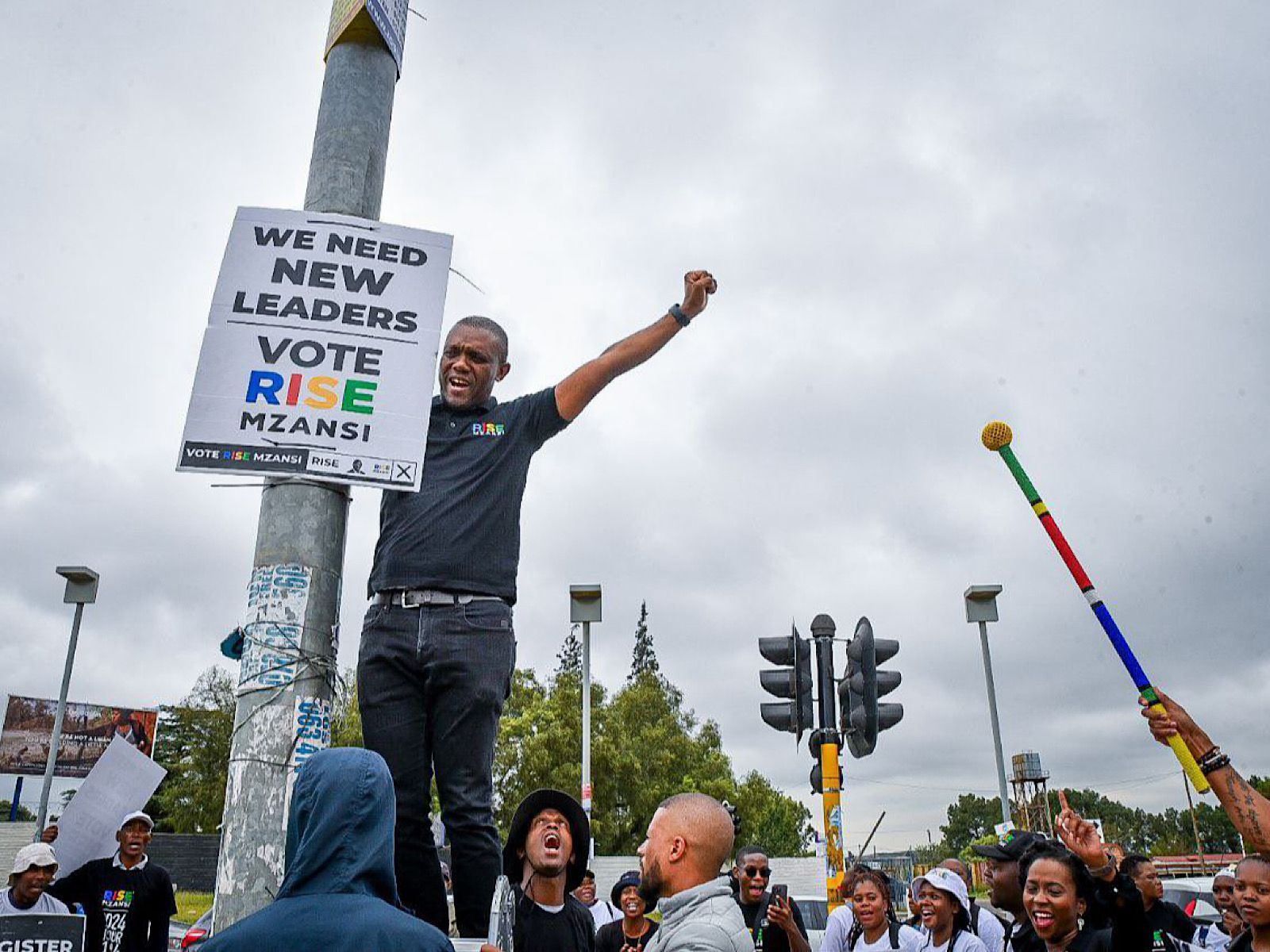
Pictured above: Rise Mzansi leader Songezo Zibi.
Image source: Rise Mzansi