
By Thabo Molelekwa for Oxpeckers
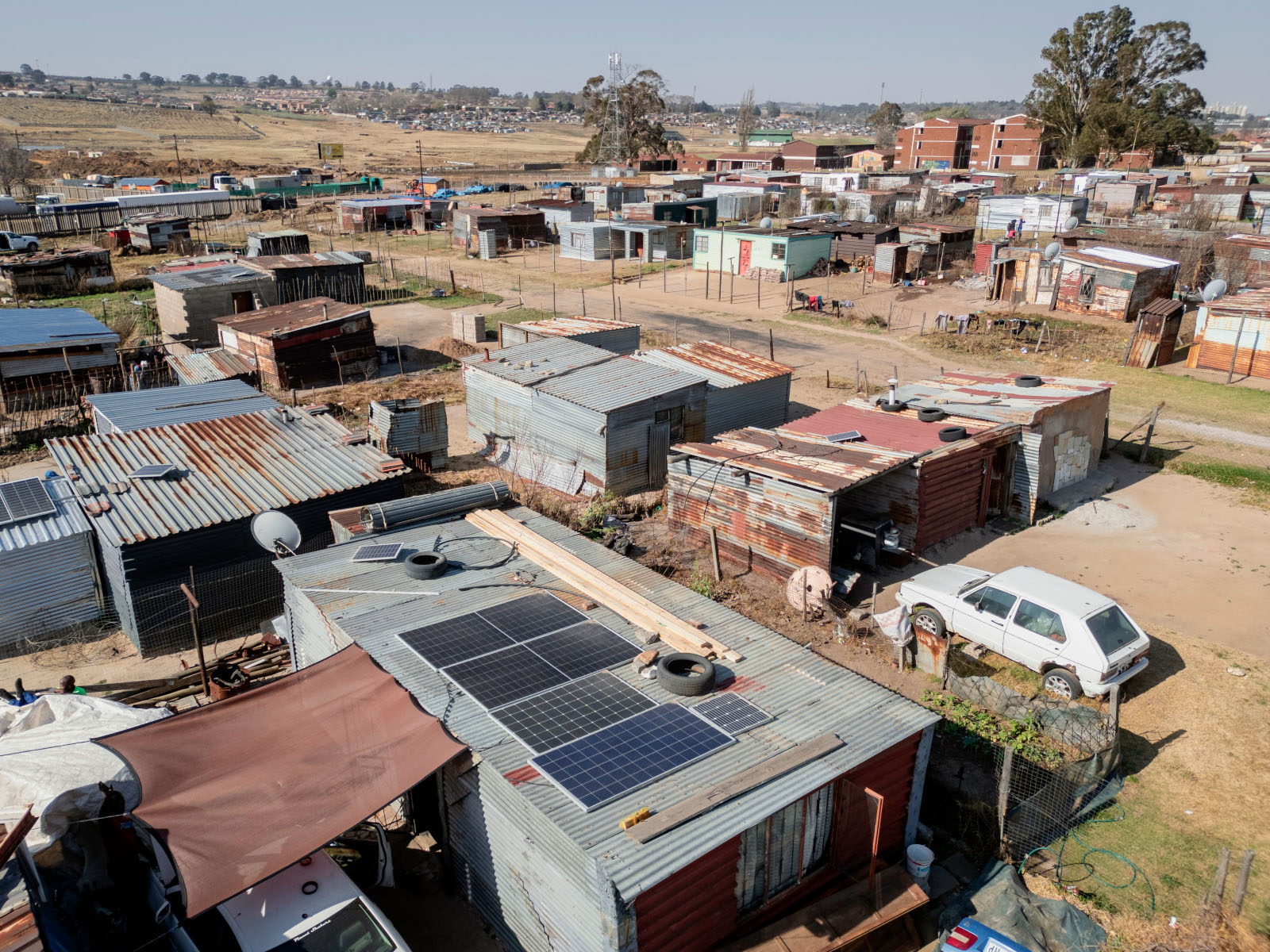
In Nomzamo, an informal settlement in the coal heartlands of Mpumalanga province, energy is no longer something handed down from Eskom. Families relocated here after floods in 2016 now power their homes through modular solar systems.
What makes Nomzamo different is not only the technology, but the principle of energy ownership. Instead of being consumers of a distant utility, residents have gained control of their own energy requirements.
As national utility Eskom prepares to launch its own renewable energy subsidiary, called GreenCo, communities like the one in Nomzamo – which means “resilience” – are testing a different idea that a just transition is not only about megawatts, but about who owns the power.
In places where the national grid dips or fails, neighbourhood-scale solar, batteries and microgrids are lighting streets, running shared freezers and keeping micro-enterprises alive.
#PowerTracker data shows at least six significant community off-grid projects are now running across five provinces.
They range from the Upper Blinkwater hybrid mini-grid in the Eastern Cape to solar home systems in Western Cape informal settlements, remote villages in the Northern Cape, and university-led pilots in Limpopo and Gauteng. Together they form a patchwork of approaches, some utility-backed, others community-driven, with varying scales and ambitions.
Nomzamo is located on the edge of Ermelo, a town that once thrived on coal mining and fossil fuel energy generation. Yet here, in the shadow of 12 power stations scheduled to close by 2035, including Camden in just two years, households remain in the dark.
Stats SA data shows that more than half a million households in the area still rely on candles for lighting, 161,000 burn paraffin, and nearly 29,000 have no source of lighting at all. For many around Ermelo, rolling blackouts are routine; for others, access to grid electricity is a dream.
The Nomzamo settlement was born from climate disaster. When floods swept through low-lying parts of Ermelo in 2016, hundreds of families were uprooted.
Local organisations and community leaders negotiated for a slice of disused mining land to resettle the displaced. Nomzamo was established on former mining ground, highlighting the complex relationship between extractive industries and community displacement in Mpumalanga.
By 2017, Nomzamo consisted of 441 households and 1,478 people, but there were no basic services: no electricity, piped water, sanitation, or waste removal. Residents describe those early years as a “double displacement”, first by floods, then by government neglect.
Zethu Hlatswayo, chair of the Khuthala Environmental Care Group, a non-profit organisation based in Ermelo, told Oxpeckers that residents began mapping out survival in the new settlement through a participatory process called We Design.
“The We Design process brought residents together to prioritise services. Energy poverty was identified as the biggest challenge,” Hlatshwayo said.
This story was produced by Oxpeckers Investigative Environmental Journalism and shared with Scrolla.Africa as part of a content partnership. Read the full investigation here.
Pictured above: Nomzamo informal settlement.
Image source: Oxpeckers