
By Zukile Majova
Political Editor
A coalition of opposition parties is pinning its attempt to remove the ANC from power on solutions to load shedding.
Load shedding is costing the country more than R300-billion a year while over eight million job seekers battle to find work as businesses are forced to cut costs.
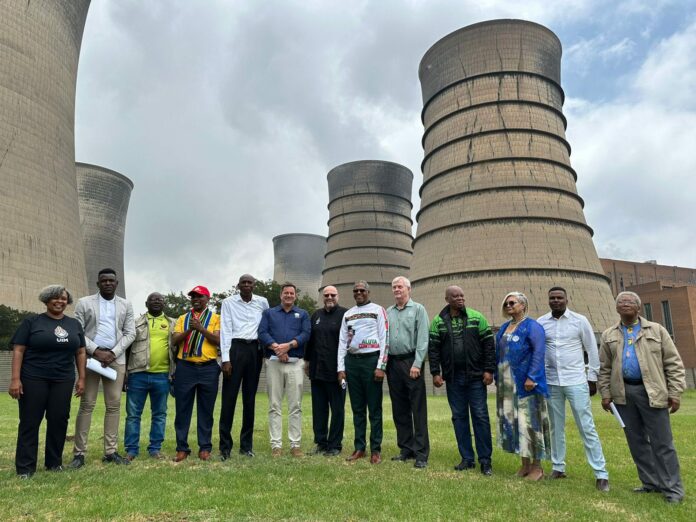
The Multi-Party Charter for South Africa led by the DA, IFP, ActionSA, FF plus and other smaller parties met at the Kelvin Power Station in Kempton Park, Gauteng, on Wednesday.
DA leader John Steenhuisen said: “The charter will establish a competitive, open electricity market, ending years of Eskom’s underperformance and bailouts.
“The Multi-Party Charter has engaged experts and adopted a three-pronged approach to end load-shedding and help secure our country’s energy future,” he said.
Herman Mashaba, the founder and leader of ActionSA, said the opposition’s strategy is to allow small towns and different communities to create and manage their own microgrids.
“We want to enable an open energy market. The Multi-Party Charter aims to pass the Electricity Regulation Amendment Bill through Parliament to clarify how the future electricity market will operate legally,” said Mashaba.
“The charter will seek to create a conducive environment for the construction of microgrids. A microgrid is a small-scale local electricity network with defined electrical boundaries that act as a single and controllable entity,” said Mashaba.
Ahead of the 29 May elections, the charter, which is now made up of 13 opposition parties, said it will be sending out the same message to all its constituencies.
Their strategy is designed to create a competitive market where different power producers can compete on an open platform, effectively reducing Eskom’s monopoly on the sector.
Numerous attempts by the ANC government to resolve the load-shedding problem have not worked and rolling blackouts are now a daily occurrence in South Africa.
Last year, President Cyril Ramaphosa created a Ministry of Electricity headed by Kgosientsho Ramokgopa to deal with the crisis, including the breakdown of generating units at various Eskom plants.
The National Treasury has also taken over Eskom’s debt of R254-billion but Ramokgopa said the utility requires a further R400-billion to fund a network of over 14,000km of cabling in the Eastern Cape, Western Cape and Northern Cape.
The ANC government remains committed to extending the lifespan of coal-fired power stations and for Eskom to remain the country’s major supplier of electricity.
Pictured above: Opposition party leaders meeting at Kelvin Power Station in Kempton Park, Gauteng.
Source: X