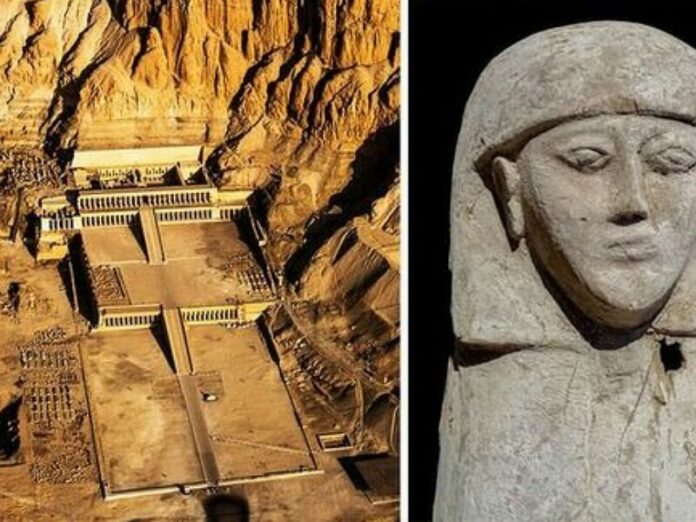
A teenage boy that was mummified and buried was set down with several jewels, including one beside his penis.
Researchers from Cairo University discovered a 2,300 years-old teenage mummy, who was heir to the throne, after being buried with 49 precious amulets.
The team used CT scans to “digitally unwrap” a mummy who had been discovered more than 100 years ago in Nags el-Hassay, southern Egypt.
Scientists found dozens of different amulets buried, with many that are made of gold. They had been carefully placed on and inside the body, the Daily Mail reported.
Among the dozens of amulets found on the body of the “Golden boy” mummy, a two-finger amulet next to his genitals, a golden heart scarab placed inside the thoracic cavity and a golden tongue inside the mouth were discovered by the scientists.
The “Golden boy” mummy had been laid inside two coffins – an outer coffin with Greek inscription and an inner wooden sarcophagus.
The mummy’s internal organs had been removed through an incision, apart from the heart while the brain had been removed through the nose and replaced with resin.
Scans showed the boy was between 14 and 15 years old and 1.28 metres tall.
The amulets represent a wide range of Egyptian beliefs. For example, a golden tongue leaf was placed inside the mouth to ensure the boy could speak in the afterlife, while a right-angle amulet was meant to bring balance.
The researchers added, writing in the journal Frontiers in Medicine, that the findings from this study suggest that ancient Egyptians valued their children and provided them with ritual treatment.
The ancient Egyptians believed that when people died, their spiritual body sought out an afterlife similar to this world. But entry into this afterlife was not guaranteed – it first required a perilous journey through the underworld, followed by an individual last judgement.
For this reason, relatives and embalmers did everything they could to ensure that their loved one could reach a happy destination.
Compiled by Mashudu Mabila
Pictured above: The mummy and its location in southern Egypt
Image Source: Daily Express