
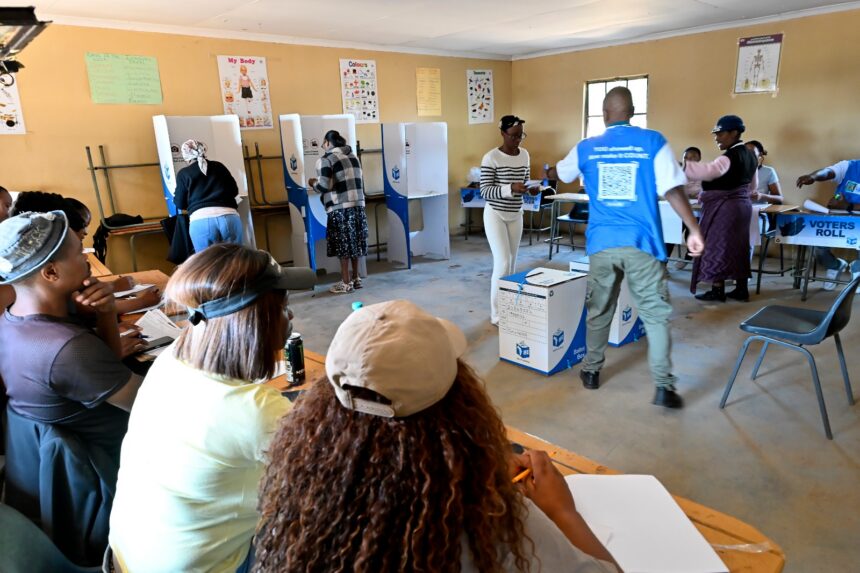
- About 12 million South Africans had voted by 5pm on Wednesday, with Gauteng recording the highest turnout as voting stations prepared to close.
- The African National Congress faces a major test in local elections as opposition parties fight for control of municipalities across South Africa.
South Africans are waiting to see who will take charge of their towns and cities after millions went to the polls on Wednesday, 4 November.
Voting stations closed at 9pm, with counting now under way across the country.
The Electoral Commission of South Africa said everyone who joined a queue before 9pm would be allowed to vote.
Gauteng led with three million voters, followed by KwaZulu-Natal with 2.5 million, the Western Cape with 1.5 million and the Eastern Cape with 1.4 million.
Limpopo recorded 1.1 million voters, while Mpumalanga had 854,901 and North West 702,133.
The Free State recorded 588,237 voters and the Northern Cape 299,381.
The figures showed a sharp rise from the 3.5 million people who had voted by 10am.
But not everyone rushed to the polls.
Some voting stations in central Durban reported low turnout, raising concerns about people staying away from the elections.
The day also brought tragedy.
A woman in her late 60s died after collapsing while waiting to vote at Shallcross Primary School in Durban.
Previn Vedan, chairperson of the African National Congress Naidu Makhanya Zone, said an ambulance was called, but the woman’s family arranged transport and took her to hospital.
The Electoral Commission said it was investigating the circumstances.
Police also investigated the theft of unused ballot papers and a voting stamp from a voting station in eThekwini.
Heavy rain and local protests caused delays at some stations in the Eastern Cape and KwaZulu-Natal.
Despite these problems, the commission said voting had gone well across most of the country.
The biggest political test is for the African National Congress.
The party lost its national majority in 2024 and now faces another battle to hold on to councils across South Africa.
Opposition parties are hoping to take control of more municipalities as voters judge how councils have handled water, electricity, roads, rubbish collection and other services.
Former president Jacob Zuma’s uMkhonto weSizwe Party is also contesting its first local government elections after winning significant support in KwaZulu-Natal during the 2024 national elections.
A record 29.2 million people registered to vote.
More than 136,000 candidates competed for 10,526 council seats across 257 municipalities.
Election officials are counting ballots at the stations where voters cast them, with party representatives and observers watching the process.
Officials will check the figures before sending the results for verification and an independent audit.
The final results are expected within seven days.
Attention will now turn to major cities, including Johannesburg, Cape Town, eThekwini and Ekurhuleni, where parties are fighting for control.
The results will decide who runs local councils for the next five years and whether parties will need to work together to govern.