By Thabo Molelekwa for Oxpeckers
More than a decade ago, South Africa launched an ambitious plan to use renewable energy as a vehicle for industrialisation. The government’s Industrial Policy Action Plan and the Renewable Energy Independent Power Producer Procurement Programme (REIPPPP) were promoted as tools for creating green jobs, developing local industries and reducing dependence on energy imports.
According to the Department of Trade, Industry and Competition, (DTIC) local production of solar modules was supposed to “stimulate manufacturing, build technical capabilities, and support long-term economic transformation”.
Yet the promise has not materialised, according to a 2024 report on the state of South African solar PV manufacturing published by GIZ, which noted that although public procurement initially drove demand, “many local factories closed or are operating below full capacity”.
A policy brief published by research institution Trade & Industrial Policy Strategies in April 2024 warned that South Africa’s renewable energy value chain had “gone through a boom and a bust”, undermining localisation ambitions.
At the centre of this industrial decline stands ARTsolar, a Durban-based solar module manufacturer once celebrated as proof that South Africa could build a local renewable energy industry. The company has embarked on a legal challenge that is a litmus test for whether localisation is real policy or empty political rhetoric.
In October 2024 ARTsolar filed an application in the North Gauteng High Court, naming 26 respondents in total – including government entities such as the DTIC and the Department of Mineral Resources and Energy (DMRE) – as well as 20 independent power producers (IPPs). Among these IPPs are major renewables developers such as Scatec, Engie, Electricite de France (EDF) Renewables, Mainstream and Enel, whom the company alleges were awarded projects despite failing to meet local-content requirements.
The application asks the court to compel these parties to prove they complied with a mandate from the National Treasury that set varying minimum thresholds of local content in solar modules used in government-backed renewable energy projects. If the respondents cannot prove compliance, ARTsolar is asking the court to declare their conduct administratively unlawful and to order corrective action – including enforcing compliance and directing the IPPs to source panels locally in line with their contractual obligations.
The company alleges that despite clear procurement regulations, the independent producers imported solar panels primarily from China and the government departments failed to enforce the rules. According to the company’s founding affidavit, ARTsolar wrote repeatedly to the DTIC and DMRE — including to the former director-general Lionel October — between 2019 and 2023, warning that imported panels were being used in state-approved projects without verification of local content. The company says it received no formal response.
“The government created the framework but then failed to enforce it,” said Eshu Seevnarayan, chairperson of ARTsolar, in an interview with Oxpeckers. “We were ready to supply the local market, but those projects went ahead using imports. That’s how localisation in South Africa collapsed.”
This story was produced by Oxpeckers Investigative Environmental Journalism and shared with Scrolla.Africa as part of a content partnership. Read the full investigation here.
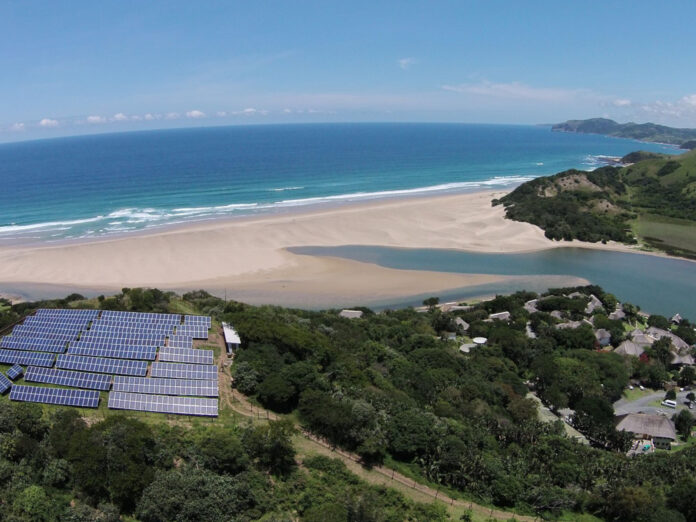
Pictured above: Durban’s ARTsolar is at the centre of a landmark High Court battle accusing government and power producers of flouting localisation laws meant to drive the country’s green industrial development.
Image source: ARTsolar
UPDATE: In a significant procedural victory for the local solar energy industry, the High Court in Pretoria ordered the Department of Mineral Resources and Energy (DMRE) to hand over the full record of decisions regarding local content exemptions. Acting Justice Mullins ruled on December 9 2025 that the department must deliver a complete index of all documents related to the RMIPPPP and REIPPPP Bid Windows 5 and 6 by January 30 2026. While the DMRE and several independent power producers argued that ARTsolar lacked the legal standing to bring the application, the court dismissed these challenges as irrelevant at this stage, affirming that the right to access the record is “automatic” in order to ensure “equality of arms” between the person challenging a decision and the decision-maker.
To protect trade secrets, the court established a strict confidentiality regime where sensitive documents – referred to as “Part B” – will be accessible only to legal teams and independent experts. Crucially, Justice Mullins rejected attempts by several power producers to block ARTsolar’s use of an independent expert, noting that lawyers alone might not be able to identify technical non-compliance within the complex solar PV modules sector. Find the court documents in the Oxpeckers Get the Data section here