- Justice Minister Mmamoloko Kubayi said the numbers had overwhelmed Home Affairs, and that the court ruling does not grant refugee status.
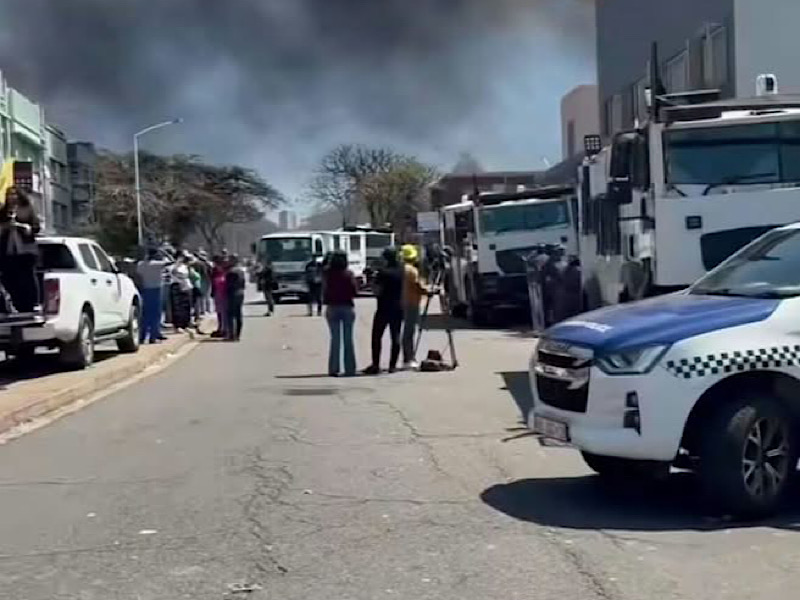
- Police used stun grenades in Gqeberha, and a fire was reported near Durban’s office, as hundreds also gathered at Marabastad in Pretoria.
Pressure and tension are building at refugee reception offices across the country where hundreds of foreign nationals have gathered to apply for asylum since a Constitutional Court ruling opened access to the system.
Following a landmark Constitutional Court ruling, the Department of Home Affairs (DHA) has faced widespread operational strain, with massive queues and severe disruptions reported at all five of the country’s Refugee Reception Offices.
At the Durban Refugee Reception Centre on Che Guevara Road, tensions boiled over into violent standoffs as the anti-migrant activist group March and March blocked entry, forcing temporary shutdowns and necessitating heavy police deployments. At the same time, hundreds of asylum seekers queued from dawn outside the Desmond Tutu Refugee Reception Office in Marabastad, Pretoria, and the offices in Gqeberha, Cape Town and Musina.
The sudden influx prompted an emergency meeting of the government’s Inter-Ministerial Committee (IMC) on Migration, which acknowledged that while individual assessments must still be conducted, the severe congestion has accelerated plans to permanently relocate inland reception facilities to South Africa’s borders.
Justice Minister and IMC chair, Mmamoloko Kubayi said thousands of people have turned up at refugee reception offices across the country, and that the numbers have overwhelmed the Department of Home Affairs.
Speaking at a media briefing on Thursday, she said the committee met urgently on Wednesday night to discuss the issue.
“And we want to say we understand the concerns of citizens when they woke up to long queues outside human affairs offices, and yet we confirmed that all refugee offices were overwhelmed by the numbers of those coming in for applications.”
Kubayi said the committee knows about the uncertainty, concern and confusion that have followed the ruling. She said the judgment does not automatically give anyone refugee status or permanent residence, and does not legalise unlawful migration.
The court found that asylum seekers may not be deported until they have been able to use the asylum system,irrespective of how they got into the country.
Kubayi said the department’s directives, and difficulties in carrying out the ruling, contributed to the sudden jump in numbers.
She rejected claims that Home Affairs offices will not be able to serve South Africans.
“It is not true that Home Affairs offices will not be able to service South Africans because they are flooded by refugee applicants,” she said.
She also acknowledged the cooperation between Home Affairs officials and police.
Thursday morning’s briefing comes as tensions between locals and anti-illegal immigration groups have escalated, with the groups vowing to continue disrupting operations at refugee offices.
In Gqeberha, police used stun grenades to disperse a group of about 30 protesters who went to disrupt asylum seekers at the refugee office. Hundreds of asylum seekers had come to apply for temporary permits. They say they fled their countries because of wars and tribal conflicts.
In Durban, hundreds of protesters carrying sticks and sjamboks confronted asylum seekers queuing outside the Che Guevara Road refugee reception centre for the third day running . Police used pepper spray as the crowd grew unruly. The office was closed and asylum seekers were told to leave.
Police advised the migrants who were queued outside the office to leave the area as the situation became increasingly concerning, with some groups calling on them to leave the country altogether.
This is a developing story.