By Doreen Mokgolo
The results of the seventh democratic elections on 29 May saw the dramatic shrinking of previously influential political parties formed as breakaways from the ANC – from 1959 to the dawn of democracy in 1994.
Robert Sobukwe’s Pan Africanist Congress (PAC) broke away from the ANC in 1959. It objected to the ANC’s relationship with communists, its belief that “the land belongs to all who live in it, both white and black”, and to its multiracial world view.
Contesting the first general election in 1994, the PAC secured five seats in the National Assembly. In the 1999 election, it received three seats and retained them in 2004.
The alarming decline in support for the PAC continued into the 2009 election, when it received 48,530 votes, securing just one seat. In 2014, its vote dropped to 37,784, affording it a single seat in the National Assembly. It saw a further drop in the 2019 election to 32,677, allowing it to retain that single seat.
In the latest election, the party’s performance slightly increased by 4,039 votes, allowing it to retain the one seat it occupies.
The second democratic elections in 1997 saw the birth of the United Democratic Movement (UDM), founded by Bantu Holomisa. Contesting its first national election in 1999, the party secured 14 seats in the National Assembly and was in the top five.
In 2004, its support dropped to nine seats, and it dropped to four seats in 2009. In 2014, the party retained its seats, seeing a slight growth from 149,680 to 184,636 votes.
In the 2024 election, the UDM received 78,575 votes, only 0.49% of the total vote. Thus, the party secured only two seats in Parliament and one in the Eastern Cape legislature.
A third breakaway from the ANC saw the formation of the Congress of the People (Cope) in 2008. Cope was among the top performers in the 2009 election, winning 30 seats with over a million votes.
But bitter leadership battles between former ANC heavyweights Mbhazima Shilowa and Mosiuoa Lekota resulted in several court cases over the years, and the party’s support suffered. In 2014, it held three seats in Parliament, but only two seats in 2019.
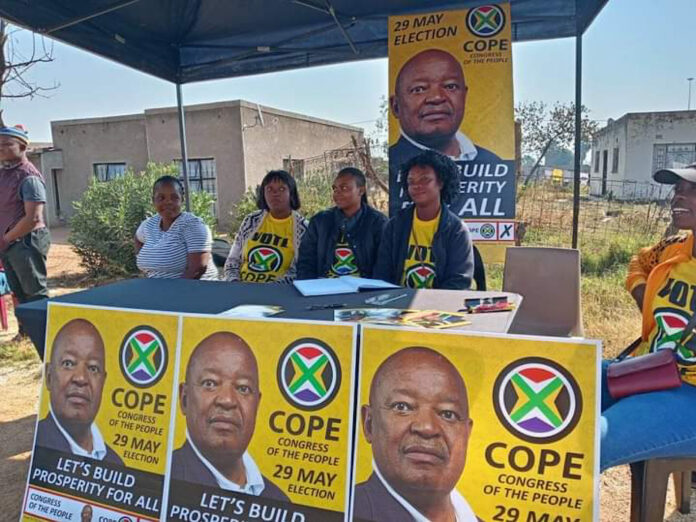
The party’s worst performance came in 2024, when it lost all its seats and representation in all provinces. It only received 14,177 votes (0.09%).
In the latest elections, Umkhonto Wesizwe (MK), a new ANC breakaway party formed in December, secured 31 parliamentary seats with over two million votes, making it a surprise big winner.
Picture above: Cope staff looking forlorn on election day.
Image source: Supplied