
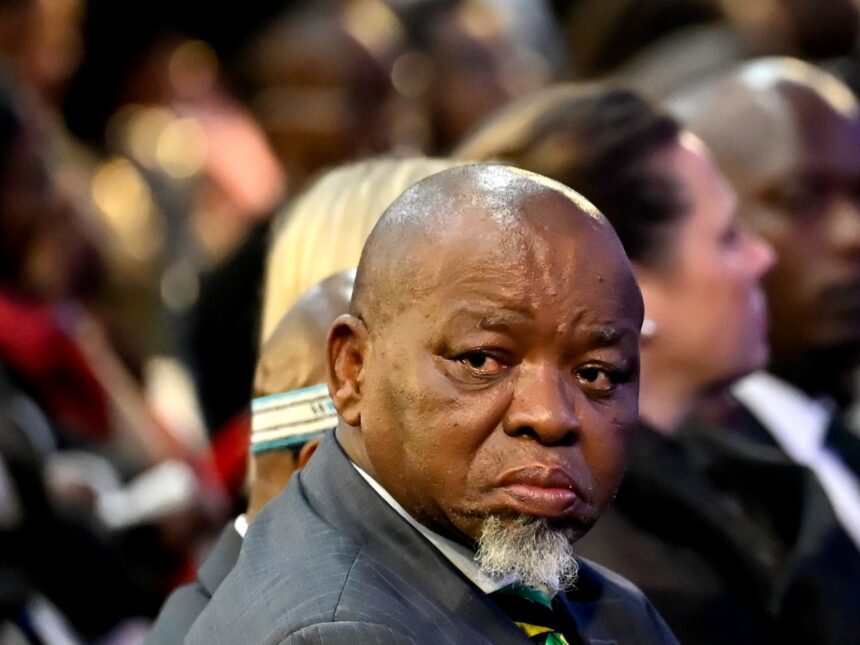
- Prince Sondaag Mabhena wants politicians jailed for threatening voters with losing social grants, following criticism of Gwede Mantashe’s election campaign remarks.
- Gwede Mantashe says the African National Congress expanded social assistance, but old age pensions existed decades before the party took power.
AmaNdebele Prince Sondaag Mabhena wants politicians who threaten people with losing their social grants if they vote for another party to face jail.
He accused the African National Congress of using government benefits to frighten poor South Africans into supporting the party.
His criticism follows a video showing African National Congress national chairperson Gwede Mantashe speaking to a woman during a door-to-door election campaign in Freedom Park.
Mantashe asked whether her grandchildren received the Child Support Grant and pointed to government housing and grants as achievements of his party.
The exchange sparked criticism from people who believed he was suggesting that government benefits depended on voting for the African National Congress.
Mabhena described such campaign tactics as extortion.
“This is what they have been doing for years and getting away with it to ordinary South Africans, claiming that if they don’t vote for the ANC their social grants will stop,” he said.
He argued that social grants were protected by law and belonged to qualifying citizens, not political parties.
The prince said traditional leaders should challenge politicians who use poverty and people’s dependence on grants to gain votes.
He also accused politicians of treating traditional leaders unfairly, particularly over land rights.
Mabhena said traditional leaders wanted representation in Parliament to challenge policies they believed ignored their communities.
He criticised the uMkhonto weSizwe Party, saying traditional leaders had cut ties with it after feeling used to attracting votes.
“That is why we cut ties with the MKP after realising that Jacob Zuma was playing with us to get more votes for his party,” he said.
Mantashe rejected criticism of his campaign remarks during an interview with Newzroom Afrika.
He said the African National Congress deserved recognition for introducing programmes to fight poverty and inequality after apartheid.
“The ANC has been governing for 32 years. It has put policies in place. We transformed the apartheid system and put new policies in place. One of those policies is actually the RDP houses,” he said.
Mantashe also defended the Child Support Grant, saying the party introduced it to fight hunger among children.
He argued that the democratic government had expanded support for poor families and made social assistance fairer.
But South Africa’s social grant system did not begin when the African National Congress took power in 1994.
State old age pensions were introduced in 1928, although most Black South Africans were excluded.
In 1944, the pension system expanded to include more racial groups, but payments remained unequal.
By 1994, old age pensions had already been equalised across racial groups following earlier reforms.
After democracy, the government expanded social assistance and introduced new protections.
The 1996 Constitution recognised the right of access to social security, including assistance for people unable to support themselves.
In 1998, the Child Support Grant was introduced to help families care for children.
Parliament passed the Social Assistance Act in 2004, setting out the legal rules for grants.
In 2006, the South African Social Security Agency began administering grants nationally.
Between 2008 and 2010, the qualifying age for men receiving old age grants was gradually reduced from 65 to 60.
These changes expanded access to government assistance.
But the money comes from public funds, including taxes, rather than political party accounts.
A person does not have to vote for the African National Congress or any other party to receive a grant.
Their eligibility depends on the law, not their political views.
A change of government also does not automatically stop social grant payments.
Any government wanting to change the system must follow the Constitution and the law.
The national government decides grant amounts through its budget, while Parliament approves spending.
Municipalities cannot decide whether pensioners receive their grants.
The debate comes as millions of older South Africans struggle with rising living costs.
Pensioners aged 60 to 74 receive a maximum of R2,400 a month, while those aged 75 and older receive R2,420.
Many use that money to buy groceries, electricity, medicine and transport.
Others support unemployed children and grandchildren.
According to the Pietermaritzburg Economic Justice and Dignity Group, a basic monthly grocery basket for a low-income family of seven cost R5,512.53 in October 2026.
That is more than double the standard old age grant.
Economic Freedom Fighters leader Julius Malema has proposed increasing old age grants to at least R4,500 a month.
But the increase remains a political proposal, not an approved payment.
For Mabhena, the bigger concern is that people who depend on grants may believe they could lose their money if they vote for another party.
Mantashe maintains that his party should receive credit for expanding government support.
The law, however, makes no link between receiving social grants and supporting a political party.
For pensioners, that means their vote remains their choice, regardless of which party introduced or expanded the grants.