
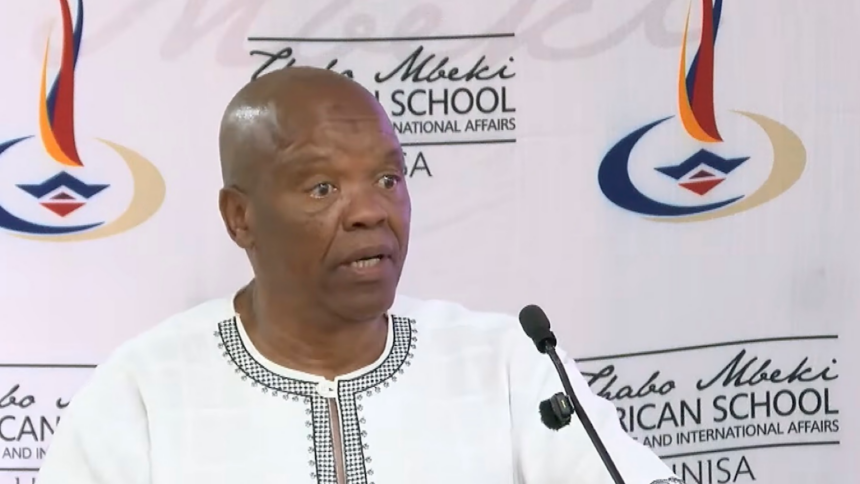
- Professor Lesiba Teffo told a Unisa migration seminar that African kingdoms recognised territorial boundaries long before European colonisation.
- Border Management Authority commissioner Michael Masiapato said a fair asylum system needs timely decisions, accessible procedures and meaningful review.
African kingdoms had boundaries long before European colonisers arrived, Professor Lesiba Teffo told a migration seminar in Pretoria.
Teffo was speaking at the inaugural Dynamics of Migration Seminar hosted by Unisa’s Thabo Mbeki African School of Public and International Affairs on 26 October.
He rejected the idea that Africans had no concept of borders before European colonial rule.
“I published and I have spoken a lot about migration and I want to say you want to talk about borders and you say no, no we don’t need borders, you don’t understand, African does have borders,” Teffo said.
He argued that communities had long used rivers, trees, stones and other landmarks to separate kingdoms, land and areas of authority.
“Borders didn’t come with a white man but they came with the existence of man,” he said.
Teffo gave examples of African kingdoms and communities knowing where one area ended and another began.
His argument reflects an important distinction in African history.
Pre-colonial kingdoms did have recognised territories and political frontiers, but these were not always fixed international borders like those used by modern states.
European colonial powers later created and formalised most of Africa’s modern international boundaries.
The Berlin Conference of 1884–85 set rules for European powers claiming territory in Africa, but historians say it did not itself draw most of the borders seen on today’s map.
Border Management Authority commissioner and chief executive Michael Masiapato also addressed the seminar.
According to posts from the Thabo Mbeki African School, Masiapato said “a fair asylum system needs timely decisions, accessible procedures and meaningful review.”
He also called for migrants’ individual circumstances to be assessed fairly and for legal routes to migration to be available.
Professor Edith Phaswana, acting executive dean of the Thabo Mbeki African School of Public and International Affairs, used South Africa’s past visa problems with the United Kingdom as an example of what can happen when immigration systems fail.
“I remember the announcement that came that the UK was going to stop the working visas for South Africans,” Phaswana said.
She said weak controls over South African passports had allowed people from other countries to misuse them.
But the 2009 UK decision did not cancel work visas for South Africans.
Britain instead ended visa-free travel for South African passport holders after raising concerns about fraud and the security of South African passports.
The British government had reviewed South Africa’s visa-free status and warned that people who were not entitled to South African passports were obtaining genuine documents fraudulently.
In February 2009, the British High Commission said abuse of the South African passport remained a serious concern.
The new requirement meant South Africans had to obtain visas before travelling to Britain, making travel more costly and complicated.
Phaswana said weaknesses in immigration systems should not be seen only as administrative failures.
She also questioned who benefits when systems fail, pointing to criminal networks and other interests.
The seminar brought academics, officials and other participants together to discuss migration, borders and how African states should manage the movement of people.