- Chicken Farm mother Yolisa Matwa says she has lost faith in the African National Congress after waking up without water or warning.
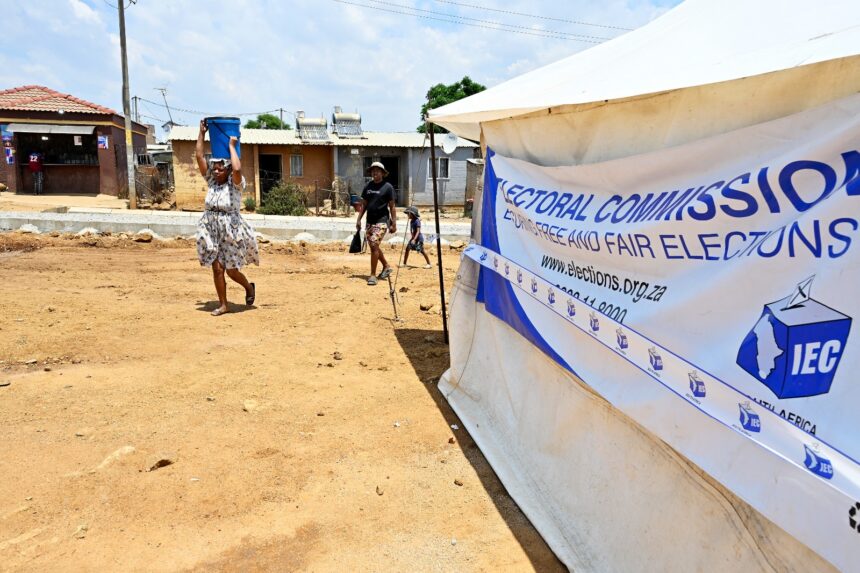
- Soweto residents carry heavy buckets of water across an uphill railway line in scorching heat while schoolchildren roam dusty roads before Wednesday’s elections.
While millions of South Africans prepare to vote for their local leaders, Yolisa Matwa is sitting at home with her children, wondering whether her vote will ever change their lives.
On Monday, 2 November, as special voting got underway across the country, schoolchildren were seen walking along the dusty gravel roads of Chicken Farm in Soweto.
It was around 11am, a time when children would normally be expected to be in their classrooms.
For Matwa, a mother living in the informal settlement near Kliptown, the day had already started badly.
She woke up to dry taps, and ‘’we heard that there is a scheduled maintenance and our water should be restored tomorrow’’
There had been no warning about the water interruption, she told Scrolla.Africa.
With her children’s school expected to release learners by 11am, she decided there was little point in sending them to school.
But the struggle does not end with empty taps.
Residents are forced to carry heavy buckets of water across an uphill railway line in the scorching heat, just to have enough water to bathe, cook, flush their toilets and clean their homes.
For families already struggling to make ends meet, fetching water has become another exhausting task.
The water they need for the simplest household chores comes at the cost of a difficult journey under the hot sun.
Matwa said the daily struggle for basic services had left her tired of voting without seeing meaningful changes in her community.
“We woke up this morning and there was no water. Nobody warned us. How do you run a home or prepare children for school when you don’t even know if water will come out of the tap?”
For Matwa, the problem goes beyond one morning without water.
She worries about the conditions in which her children are growing up and whether their lives will be any better than hers.
Chicken Farm, an informal settlement near Dlamini and Pimville, has faced long-running problems with water, sanitation, electricity and roads.
Residents have previously protested over the lack of basic services.
Now, just days before the local government elections on Wednesday, 4 November, work has started on tarring some of the gravel roads.
The roadworks offer some hope to a community where residents have lived with dust and poor infrastructure.
But they also raise questions about the African National Congress’s record of delivering services.
Matwa is not convinced that the changes are enough.
‘’Why has it taken so long for the roads to receive attention? And why are residents still waking up without water?’’, asked Matwa
But roadworks could make a real difference to families who use these streets every day.
Better roads could make it easier for children to reach school, residents to travel to work and vehicles to move through the settlement.
But roads are only one part of what the community needs.
Families also need reliable water, proper sanitation and electricity.
Matwa said she had lost faith in the African National Congress and would only consider voting if another political party took charge.
Her frustration raises a wider question about the relationship between voters and the people they elect.
Local government is responsible for many of the services that shape everyday life, including water, sanitation and local roads.
The African National Congress should be given an opportunity to explain its record in the area and what it plans to do about services that remain poor.
For Matwa, however, the most painful part of the situation is what it means for her children.
As special voting takes place on Monday and Tuesday, millions of South Africans are preparing for the main local government elections on Wednesday, 4 November.
Political parties are asking voters to trust them with another term in office.
In Chicken Farm, the work on the roads shows that improvements are possible.
But the dry taps, residents carrying heavy buckets across the railway line and children walking the streets during school hours show why families are demanding answers.
For Matwa, the question is no longer just who wins the election.
It is whether those who win will remember families like hers once the campaigning is over.
And when the election posters come down and the votes have been counted, will the children of Chicken Farm still be walking dusty roads while their parents struggle uphill with buckets of water?