- Earthlife Africa and community groups from three provinces will address Nersa’s public hearing on Eskom’s 2027/28 tariffs on Thursday.
- They want the 50-unit free electricity allocation raised, with one senior citizens’ group calling for at least 350 units a household.
Community groups will ask the National Energy Regulator of South Africa (Nersa) on Thursday, 8 October, to reject Eskom’s proposed electricity tariff increase and to raise the amount of free electricity that poor households get.
Earthlife Africa Johannesburg and partner organisations from Gauteng, the Eastern Cape and Limpopo will make oral presentations at Nersa’s public hearing on Eskom’s application for 2027/28. They say the proposed increases would deepen energy poverty and add pressure on households already struggling with the cost of food, transport, housing and other essentials.
It helps to know what is being decided. Nersa has already approved how much money Eskom may collect. The hearing deals with how that is turned into tariffs for different customers. Eskom submitted the application on 31 July, and written comments closed on 2 October.
Nersa’s final decision is expected on 26 November. If approved, customers Eskom supplies directly would pay an average of 8.83% more from 1 April 2027. Municipalities would pay Eskom 8.84% more from 1 July 2027. What households in a municipality pay depends on their municipality’s own tariffs.
Earthlife Africa’s Thabo Sibeko said the groups’ main question is a simple one.
“At the heart of communities’ concerns is a simple question: if Eskom made a profit last year, why should households have to pay more for electricity? How much profit is enough when families are already being forced to choose between electricity and food? These are not luxuries but bare necessities, and Nersa has a responsibility to protect people from a pricing system that pushes households further into poverty.”
Eskom reported an after-tax profit of R30.3-billion for 2025/26, according to Parliament’s Portfolio Committee on Electricity and Energy.
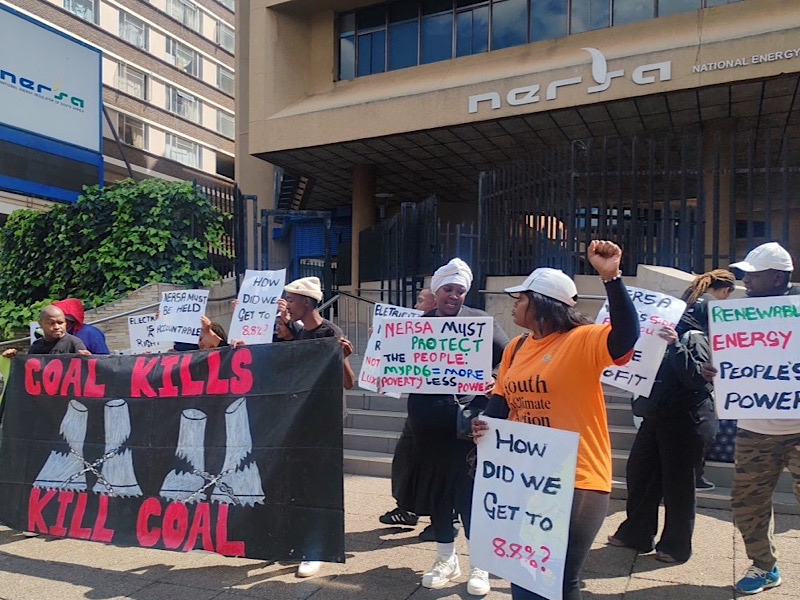
On Friday, 2 October, members of the Women in Energy and Climate Change Forum, Grassroots for Climate Action and the Climate Justice Action Group joined Earthlife Africa Johannesburg in a placard demonstration outside Nersa’s head office in Pretoria. They handed over written comments and demands on Eskom’s pricing applications, including tariffs and Free Basic Electricity.
The groups say high prices are already hurting household livelihoods, small businesses, education and access to essential services. Women who run businesses such as chicken farms and sewing enterprises say rising costs threaten their fragile incomes. Families rely on electricity for studying, internet access, refrigeration and essential health needs.
A representative of the Women in Energy and Climate Change Forum said, “Families are choosing between food and electricity, women-run businesses are struggling to survive, and children are affected when households cannot afford the electricity and connectivity they need for their education.” The forum wants Nersa to support renewable energy that is owned by communities.
The groups say the 50 kilowatt-hour a month Free Basic Electricity allocation is too small and hard for eligible households to get. They want it raised and better targeted at households in energy poverty.
Zodwa Rannyadi of Soweto Cultural Senior Citizens said, “For unemployed people, 50 kilowatt-hours is too little, the minimum should be 350 kilowatt-hours per household.”
Electricity and Energy Minister Kgosientsho Ramokgopa said on 25 September that the R21-billion set aside each year for free basic electricity often does not reach households, and that the government wants Eskom to pay it directly to them.
The Earthcare Action Network says Nersa must judge Eskom’s application against the reality of energy poverty, not only the utility’s need for revenue.
“Consumers should not finance unjustified or inefficient costs,” a network representative said.
The network wants Nersa to hold Eskom accountable, and wants transparent reporting on who receives Free Basic Electricity.
Bongani Dlamini of Tshwaranang said the demonstration reflected growing frustration among communities facing rising living costs.
“When electricity becomes unaffordable, people do not simply stop needing energy. They are pushed towards difficult and unsafe choices, while households already under financial pressure fall deeper into poverty.”
Mokgethi Khumalo of Ezamathole said communities should not be seen only as consumers who must pay more.
“We want communities to become producers of clean energy through rooftop solar and locally owned renewable-energy projects. This can create jobs, improve energy security and give people a stake in the energy system.”
Earthlife Africa’s Ulrich Steenkamp said Eskom must be open about where tariff money goes.
“Nersa must require Eskom to show clearly how every additional rand collected from consumers will improve the system. Eskom must account publicly for tariff revenue, loans and development finance, and show how these resources are addressing infrastructure maintenance, reliability, pollution and environmental compliance.”
The organisations hope Nersa will use the hearings to listen to the public. Their message is to reject the increase, strengthen Free Basic Electricity and demand more accountability from Eskom.