Listen to this article.
By Anita Dangazele
- Minister Kgosientsho Ramokgopa wants Eskom to pay free basic electricity directly to households, cutting municipalities out of the process.
- He says municipalities receive R21 billion a year for the benefit but often redirect it to other spending pressures instead.
Electricity and Energy Minister Kgosientsho Ramokgopa says municipalities are redirecting money meant to give poor households free basic electricity toward their other spending pressures instead, and government now wants Eskom to pay the benefit directly, cutting municipalities out entirely.
“There’s a 21 billion rand annual allocation for poor households to get free basic electricity, they are not getting it because the mechanism of getting it to the end consumer goes through municipalities. Municipalities are under pressure, when they receive that money they reallocate it to other spending pressures,” Ramokgopa said on Friday.
Government studies have found that more than 2.3 million households should qualify for free basic electricity, but only around 450,000 currently receive it. Eskom’s own group chief executive, Dan Marokane, has separately said that of nearly 10 million households who could qualify nationally, only around 2 million actually get their free units each month.
Ramokgopa said the plan is to build a new system, working with Eskom, that pays qualifying households directly.
“We are working with Eskom to say design a platform, a model that is going to help us to directly support the indigent household without the money going through municipalities, because in the first instance it is meant to support the poor,” he said.
He said smart meters and microgrid solutions would help improve both access to the benefit and how reliably it actually reaches people.
“We are going to ensure that everyone that is entitled to free basic electricity gets it.”
He also linked the issue directly to why electricity is so expensive for everyone. Money municipalities and Eskom can’t recover from unpaid debts often ends up factored into the tariffs paying customers are charged.
“It’s got implications on the cost of electricity, because that which they can’t recover on the debt side, they generally factor it into the tariff regime, and it’s something that we want to avoid going forward,” he said.
He said electricity’s cost hits poor households hardest, given how much of their income it takes up.
“Electricity is exceptionally expensive, and in fact its adverse impact is disproportionate on the poor because of the size of their income.”
Free basic electricity currently gives qualifying households 50 kilowatt-hours a month, though government has floated raising that to between 200 and 300 kilowatt-hours.
Energy analyst Chris Yelland has warned that expanding the benefit significantly could create a funding gap far bigger than the current R21 billion budget.
Municipalities themselves are already deeply indebted to Eskom, owing more than R100 billion, much of it because they in turn are owed huge sums by households, businesses and government departments that haven’t paid their own bills.
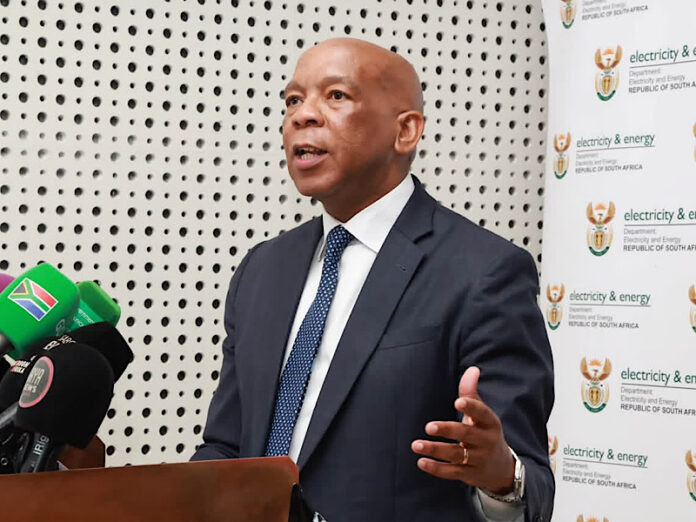
Pictured above: Electricity and Energy Minister Kgosientsho Ramokgopa promises a plan to ensure poor households get free electricity.
Image source: Department of Electricity and Energy