
By Zukile Majova
Political Editor
It is not the power of the sun or wind energy that is keeping ANC bosses awake at night.
Not even load-shedding gives them sleepless nights.
Comrades are spooked by the thought of R300 billion passing them by.
They fear a repeat of the Transvaal gold rush of the 19th century, when a dash for a quick buck made white pioneers millionaires and billionaires.
Black people who worked in the mines continued to live like peasants in their own land for the next 100 years.
Until now, the discovery of minerals has enriched others, but not the black majority.
And now a modern-day gold rush is upon us and begins with the injection of over $8.5 billion into the country’s Just Energy Transition by developed countries.
At least R300 billion is expected to go into projects outlined in the Green Hydrogen National Programme.
While recognising the inevitability of the migration from coal to renewable sources of energy, Luthuli House has been hoping to delay the transition.
It needs to manage it on its own terms – and to make sure their people are ready to eat.
Energy and Mineral Resources Minister Gwede Mantashe is leading the opposition to renewable energy.
He talks about a “people-centred” policy, but for the ANC “people-centred” really means “politically connected” as in the BBB-EE policy that has enriched the ANC’s politically connected business families.
Billions of rands are lost every year to thugs masquerading as local “business forums” who demand a 30% BEE share of every contract awarded to genuine South African companies.
Over R2 trillion of public money has gone to BBB-EE firms over the past 20 years, with little evidence of black industrialists to point to.
The ANC has a long history of securing energy sector contracts to enrich itself.
And coal supply contracts have been a fat cash cow.
For instance, it received massive kickbacks from Hitachi Power Africa – a company that was 25%-owned by the ANC’s investment company, Chancellor House. It also received boiler contracts from Eskom for Kusile and Medupi power stations to the tune of over R40 billion. Guess who paid?
So the real issue of the energy transition is: who gets what share of the pie?
But the now out-of-control rolling blackouts have forced the genie out the bottle and there is no getting it back in.
People and businesses lose eight to 12 hours of electricity a day and there has been load-shedding every day so far in 2023.
Thousands of people of Komani, also known as Queenstown, in the Eastern Cape took to the streets this week – gatvol after 10 days without electricity.
They won’t say no to reliable clean energy; they don’t care whether it comes from the Mpumalanga coal belt or the wind farms of the Northern Cape.
More marched to the ANC head office on Sauer Street, in Johannesburg, demanding answers.
This week US Treasury Secretary Janet Yellen was in the country with an unequivocal message: The horse has bolted, comrades, the green economy is here.
If you want to eat, you had better make sure your kitchen is in working order.
By Zukile Majova
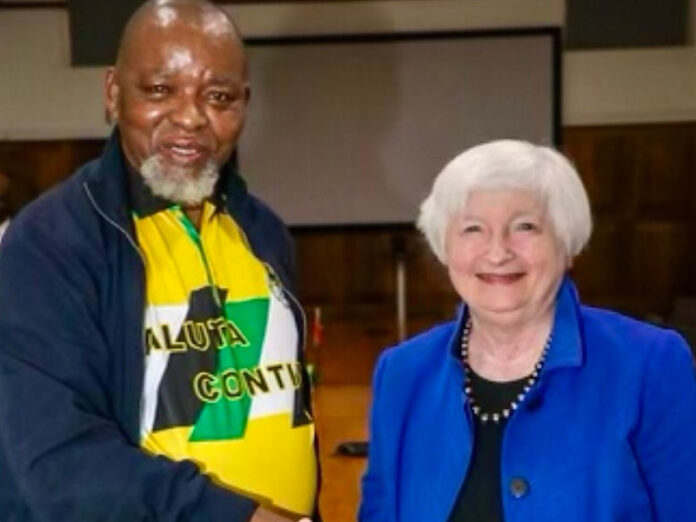
Pictured above: US Treasury Secretary Janet Yellen meets ANC National Chairman Gwede Mantashe
Source: @SecYelln