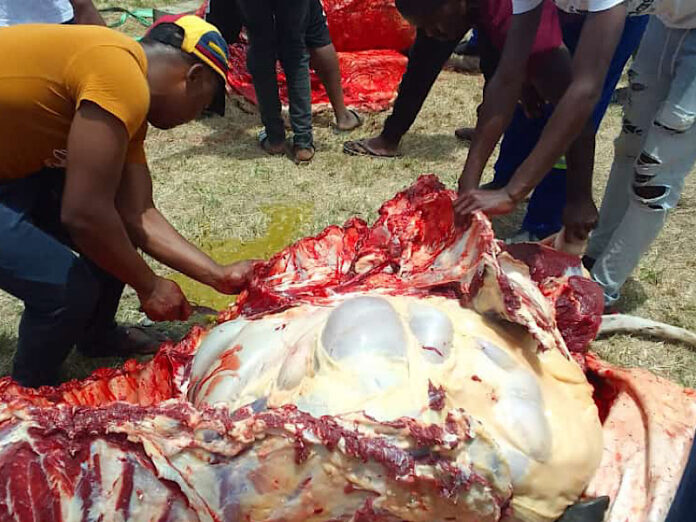
Letter from Mount Frere: Zukile Majova says multiple important events happening at once were great for feasting – but not so good for the cattle
The first time you see Eastern Cape people eating meat, and I mean really eating meat, you’d be traumatised.
I am convinced that out there in the southeastern hinterlands of South Africa live eight million two-legged carnivores.
Even at over 40 years of age, I still feel overwhelmed and dazed when I walk into a village kraal with four or five cattle being slaughtered for a single-family feast.
Such a feast is done to mark a special occasion — like a year after the death of the head of the family or his wife.
It’s a symbolic cleansing of the entire family from a whole year of mourning. Young and old dress up in beautiful Xhosa traditional garments and jewellery – all clearly resonating with the origins of the Xhosa people from the Nguni nation to Central African tribes.
The centrality of cattle – Nguni cattle in particular – to the lives of my people sees these beasts raised from calves for specific ceremonies of the future.
When a boy undergoes his rite of passage to manhood, his father would have picked a specific ox, or specific oxen, two or three years earlier to be slaughtered upon his return.
Excess slaughtering is quite common in December, when the migrant workers return from Johannesburg, Durban, Cape Town and Gqeberha.
But this December-January period was worse. Various ceremonies collided – weddings, imijadu (end of the circumcision period), imicimbi (traditional ceremonies) and most recently the better than expected matric results.
These most marginalised people, living in the poorest region of South Africa, can afford to slaughter so much livestock.
They are born herders of livestock, with some homesteads, like in my family, having hundreds of goats, sheep and cattle, mainly as sources of food.
At least 30% of all the livestock in the country is found in the Eastern Cape, unfortunately bringing very little commercial benefit to local communities.
Blame the government for failing to create trading points for the local people, resulting in so little commerce being derived from so much abundance of livestock.
Beautiful Nguni cattle hides go to waste. There is no established commercial system for collecting milk from villages, so it goes to waste. Despite its numerous health benefits, no one bothers with goat’s and sheep’s milk, because there is no market. Only sheep’s wool has an established market in the region.
Important tip: if you are ever invited to the Eastern Cape for a feast, bring your own knife, because this lot doesn’t share knives when eating meat.
Pictured above; Celebrating the better than expected Matric results in the Eastern Cape
Source: Zukile Majova