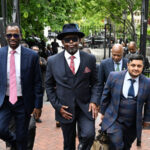
- Fadiel Adams denied Brown Mogotsi helped him open cases against senior Crime Intelligence officers, saying late General Andre Lincoln advised him instead.
- Professor Brian Williams rejected any suggestion that his late friend General Andre Lincoln would have encouraged unlawful or unethical conduct.
Suspended Member of Parliament Fadiel Adams returned to the Madlanga Commission on Thursday with his credibility under pressure and some of his biggest claims being challenged.
His appearance followed a bruising day of testimony in which contradictions emerged over his evidence and how he obtained information about Crime Intelligence.
Questions have also been raised about the Political Killings Task Team and the Investigating Directorate Against Corruption.
Adams denied that businessman Brown Mogotsi played any role in helping him open criminal cases against senior Crime Intelligence officials at Orlando Police Station.
Instead, Adams said his contact was the late General Andre Lincoln.
He maintained that Lincoln advised him to lay criminal charges.
But Lincoln died last year and cannot appear before the commission to confirm or dispute Adams’ version.
Adams has also been unable to explain why he did not present documents linked to the criminal cases to Parliament, despite their possible importance to the serious allegations he was making.
During earlier testimony, Adams denied unlawfully obtaining or distributing classified Crime Intelligence documents.
He claimed the documents were slipped under the door of his parliamentary office.
Adams said the information raised concerns about alleged corruption, secret funds, police vetting and the handling of investigations.
He also rejected suggestions that his criticism of the Political Killings Task Team was driven by personal motives.
Adams said his concerns were about accountability and money.
He claimed the task team had an annual budget of R100-million while dealing with about 130 murder dockets over three years.
But his decision to name Lincoln as the person who advised him to open criminal cases has now been challenged.
Professor Brian Williams, who described Lincoln as his lifelong friend, brother and comrade, strongly rejected any suggestion that Lincoln would have encouraged unlawful or unethical conduct.
“As a lifelong friend, brother and comrade of General Lincoln, and as someone whom Andre publicly identified as his mentor, I feel compelled to place the following on record,” Williams said.
Williams, an anti-apartheid activist and labour law expert, said Lincoln held KwaZulu-Natal Police Commissioner Lieutenant-General Nhlanhla Mkhwanazi in high regard.
He also said he had introduced Lincoln to African National Congress liberation politics through uMkhonto weSizwe.
“Our relationship was one of deep personal trust, friendship and comradeship,” Williams said.
He rejected attempts to portray Lincoln as someone who “encouraged, facilitated or endorsed unlawful or unethical conduct”.
Williams was also unhappy that Lincoln’s name was being drawn into allegations after his death.
“His name should therefore not be invoked in a manner that unfairly attributes motives, decisions or conduct to him that he cannot personally address,” he said.
Williams urged the commission to carefully test the evidence before deciding which testimony was reliable.
“General Andre Lincoln deserves to be remembered and assessed based on the life he lived, the principles he upheld and the contribution he made to South Africa, rather than through allegations made after his death,” he said.
Adams has also faced difficult questions about Mkhwanazi’s claim that he was a “hired gun” for criminal cartels.
Adams rejected the accusation.
He said his efforts to fight crime had instead made him a target.
Adams claimed investigators had obtained a recording lasting between three and four minutes involving former gang boss Faik Moses.
He said the recording supported his claims about threats against him.
“They have got a three-minute or four-minute recording of Moses speaking to me, not denying that this is what happened,” Adams told the commission.
Adams also claimed the information pointed to a plot involving Cape Town Democratic Alliance councillor JP Smith.
Mkhwanazi has presented a very different picture.
He has described the alleged campaign against senior police officials as “State Capture 2.0”, claiming it was aimed at weakening important police operations.
Mkhwanazi has also accused Adams of accessing and distributing classified Crime Intelligence information without the required security clearance.
He claimed Adams’ affidavit and leaked intelligence were later used by the Investigating Directorate Against Corruption to obtain subpoenas and speed up investigations.
The fallout has reached senior levels of the South African Police Service, with Crime Intelligence head Lieutenant-General Dumisani Khumalo and National Police Commissioner Fannie Masemola among the senior figures drawn into the controversy.
Adams insists his actions were aimed at exposing what he believed was corruption.
Mkhwanazi argues that they formed part of a wider attempt to destabilise the police.
Those competing versions are now being tested before the Madlanga Commission as Adams faces further questions over where his information came from, who helped him and what he did with it.
The inquiry continues on Friday.
Pictured above: Suspended Member of Parliament Fadiel Adams returned to the Madlanga Commission as his claims came under increasing scrutiny.
Image source: Palesa Matlala