By Tulani Ngwenya for Oxpeckers
For decades residents of eMbalenhle, a large township in Govan Mbeki Municipality in Mpumalanga, have lived and died in the plumes of Sasol’s Secunda plant.
At the heart of the Secunda complex is a process that turns coal into synthetic oil. Professor Harro von Blottnitz at the University of Cape Town’s department of chemical engineering explained to #PowerTracker that every year about 35‑million tonnes of coal are fed into massive gasifiers, which break the coal down into gas. This gas is cleaned with some of the carbon removed as carbon dioxide, and then converted into liquid fuels using a chemical process called Fischer‑Tropsch.
The plant also produces by‑products like ammonia, but it releases harmful pollutants such as hydrogen sulfide, the gas that smells like rotten eggs.
“Every now and then, when the unit dealing with this is not working and the wind blows from the east, this can be smelt in Johannesburg” Von Blottnitz said.
In the end, Secunda refines about eight billion litres of fuel each year, meeting nearly a third of South Africa’s demand, while its coal boilers generate enough steam and electricity to power a medium‑sized city.
A new report released on September 7 2026 by the Centre for Research on Energy and Clean Air (CREA), a global independent research organisation, estimates that the air pollution from the Sasol Secunda complex causes about 1,000 premature deaths every year, corresponding to 23,800 years of life lost annually.
“Air pollution from the complex is estimated to have imposed a substantial public health burden over the 2024/2025 financial year,” CREA states in the report, titled The hidden cost of coal-to-liquids in South Africa: Health impacts of air pollution from Sasol Secunda.
CREA estimates that Secunda’s pollution results in people living with serious illnesses every year. In total, it adds up to about 2,600 years lived with disability annually – including 600 years from chronic lung disease (COPD), 1,600 years from diabetes and 400 years from stroke.
These figures show how the plant’s emissions don’t just cause deaths, but also long‑term illnesses that reduce quality of life, the report states. It estimates there are 260 new cases of childhood asthma annually, with 1,300 children living with asthma due to exposure, alongside 820 low-birthweight births and 1,100 pre-term births each year.
Acute impacts are visible in healthcare data: 2,030 asthma emergency room visits annually, including 930 among children aged 0-17. “The facility’s [Sasol Secunda] emissions contribute to a health burden that begins early in life and can have consequences beyond the immediate period of exposure,” CREA warns.
The report calculates 468,000 sick-leave days are taken each year due to pollution-related illness, costing the South African economy approximately US$1-billion (R19-billion) a year. “The health and economic costs of this pollution are borne largely by society rather than the polluter,” CREA states in the report.
#PowerTracker spoke to residents of eMbalenhle for whom Secunda’s emissions are a daily reality.
“The emissions are harmful to our health and for everyone in this community. It is a common occurrence that children will constantly miss school days due to respiratory sickness,” said Khehla Mahlangu, chairperson of MS Environmental Projects, a local non-profit organisation.
Another member of the organisation, Fana Sibanyoni, said: “People have to undergo medical examinations before they can be employed in Sasol, and this becomes a drawback for them because they fail those medical tests, so it affects their daily lives and source of living, and most of them are unemployed.”
“Most of the education and awareness campaigns that have been done by the corporates are just ticking-box exercises,” Sibanyoni added.
For Martha Nkosi, the toll is written on her body and that of her child. “We have challenges with breathing, smells, headaches and sinus. I am partially blind because of air pollution. You swell up, you vomit, develop headaches, shortness of breath… We have also learnt that this air pollution causes miscarriages,” she said.
“Hospitals and clinics do not have medication; they just give you painkillers… My child could not eat for two weeks, and they said he has fungi inside his intestines and the skin, and even now, he is not eating properly, and it was all caused by the air pollution,” Nkosi said. “If you plant anything in the ground, it dies. Even if the spinach grows, it has no taste and takes a long time to be cooked… I am afraid and scared because my death is close; I can pass on any time,” she said.
Oxpeckers sent detailed questions to Sasol and the Department of Mineral and Petroleum Resources, but neither had responded at the time of publication.
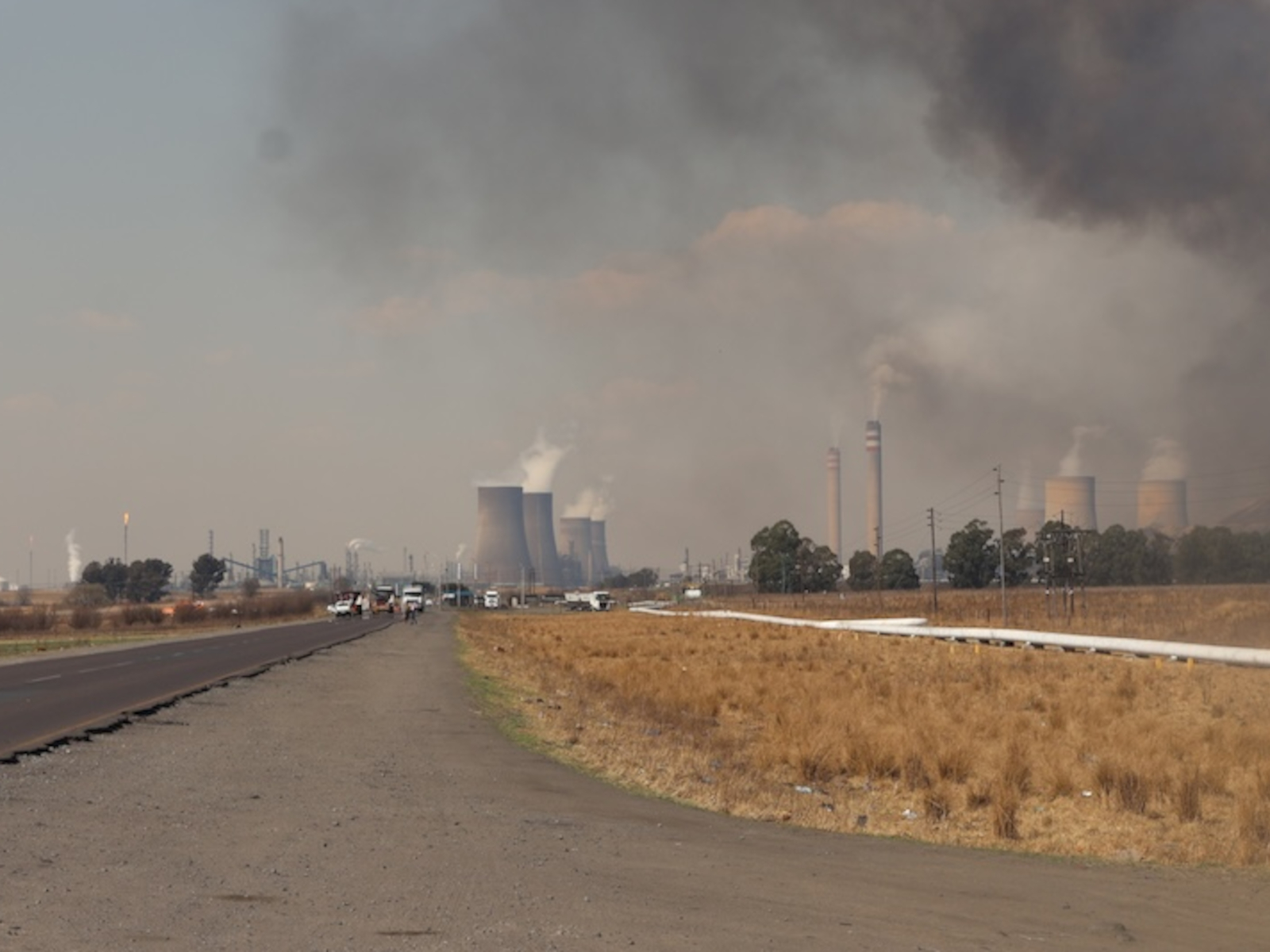
Pictured above: A dark plume rises from the ash dumps beside Secunda’s cooling towers, leaving the air thick with the impact of coal‑to‑liquids power.
Image source: Tulani Ngwenya