
Listen to this article.
By Rorisang Modiba
- A new tool called Creative Weight Attribution aims to track how much AI copies from an artist’s songs, so they can be paid.
- An audit found more than 200 South African musicians’ songs used to train AI programmes, without permission or payment.
South African musicians could soon start getting paid when AI programmes use their songs to learn, thanks to a new tool in development called Creative Weight Attribution.
AI programmes learn to make music by studying real songs first. Companies feed them thousands of tracks so the AI can pick up patterns in the beat, the voice and the style. Once it has learned enough, it can create new songs that sound similar to what it studied, usually without paying the original artist a cent.
Creative Weight Attribution is being built to measure exactly how much an AI system borrowed from a specific artist’s music. If it works, that measurement could be used to automatically pay artists a fair share whenever AI uses their songs.
The tool comes from a partnership between the Berlin AI Think Tank and local music rights groups, including the Southern African Music Rights Organisation, known as Samro, along with SAMPRA and CAPASSO. It was announced at the Africa Rising Music Conference in Johannesburg.
The push for a solution follows an audit that found the scale of the problem is bigger than many realised. Cybersecurity firm Cybersec Clinique, led by researcher Doreen Mokoena, found more than 200 South African musicians’ songs hidden inside huge AI training collections.
Amapiano star Kabza De Small’s songs appeared 360 times in these collections, DJ Maphorisa’s 270 times, gospel group Spirit of Praise’s 212 times and rapper Nasty C’s 193 times.
“The biggest export South Africa never authorised may be its culture,” Mokoena wrote when she shared the findings.
Samro said South Africa currently has no law regulating how AI companies use music to train their programmes, leaving musicians unprotected.
“At present, there is no specific legislation regulating the use of artificial intelligence in South Africa, which means music collecting societies like Samro are operating in a rapidly evolving and uncertain environment,” Samro said.
Samro said it is working with lawmakers to close that gap, while some record labels, including Gallo Records, have already started taking steps to stop AI systems from using their catalogues without permission.
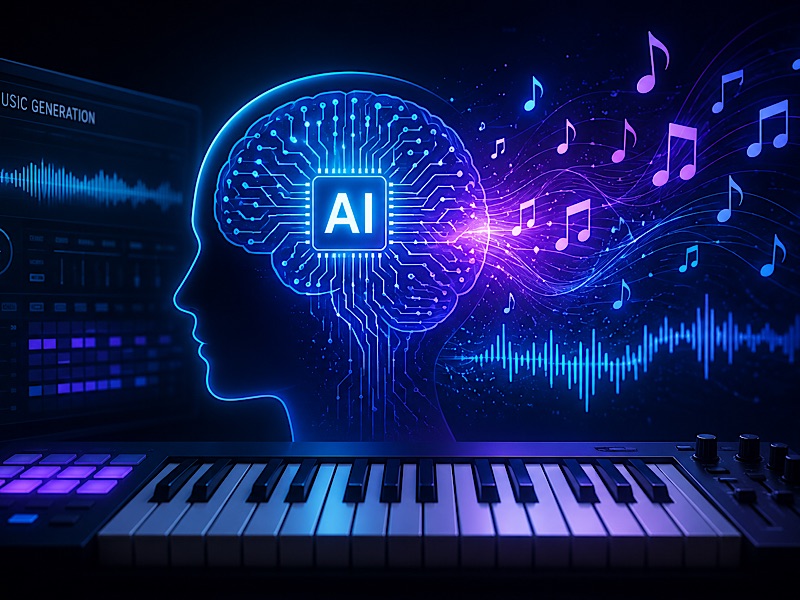
Pictured above: An illustration showing how AI systems learn from and generate music.
Image source: AI-generated