When King Mswati III’s praise singer began chanting in Durban, the room changed, heads of state stood, protocol took over, and Africa arrived in full, writes Celani Sikhakhane in Royal Mzansi.
King Mswati III of Eswatini, Africa’s last absolute monarch, brought a distinctly African flavour to the 46th Ordinary Summit of SADC Heads of State and Government, held in Durban this week and attended by leaders from all 16 SADC member states.
His arrival stood out from the rest. As his praise singer, or imbongi, chanted his royal genealogy in siSwati, the mood inside the Inkosi Albert Luthuli International Convention Centre shifted, named after a respected traditional leader from Groutville, near Stanger in northern KwaZulu-Natal, the venue took on a different energy the moment the King’s imbongi began.
King Mswati kept his full royal protocol intact throughout, with heads of state reportedly standing as his praise singer chanted him to his seat, a moment that stood in contrast to the summit’s otherwise formal, Western-style proceedings.
It’s worth noting that King Mswati’s rule itself remains a subject of real controversy. Eswatini is the only remaining absolute monarchy in Africa, political parties are banned, and human rights groups have repeatedly criticised his government over the lack of multiparty democracy. His ceremonial reception at events like this one continues to draw objections from pro-democracy campaigners, even as his cultural presence is embraced elsewhere.
Away from the summit, King Mswati also received a warm welcome from staff at the Oyster Box Hotel, who greeted him with traditional Zulu songs and a bouquet of flowers.
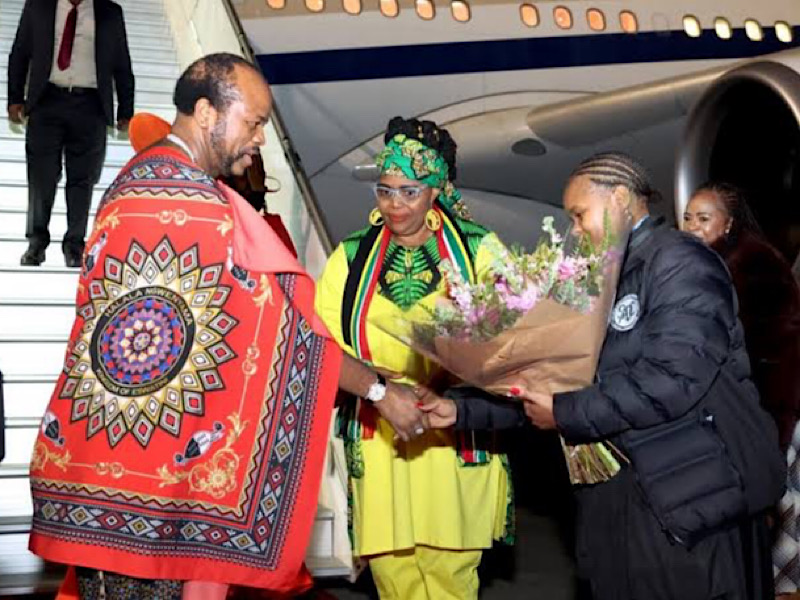
Pictured above: King Mswati III being welcomed by Water and Sanitation Minister Pemmy Majodina in Durban ahead of the SADC Summit.
Image source: Presidency ZA