
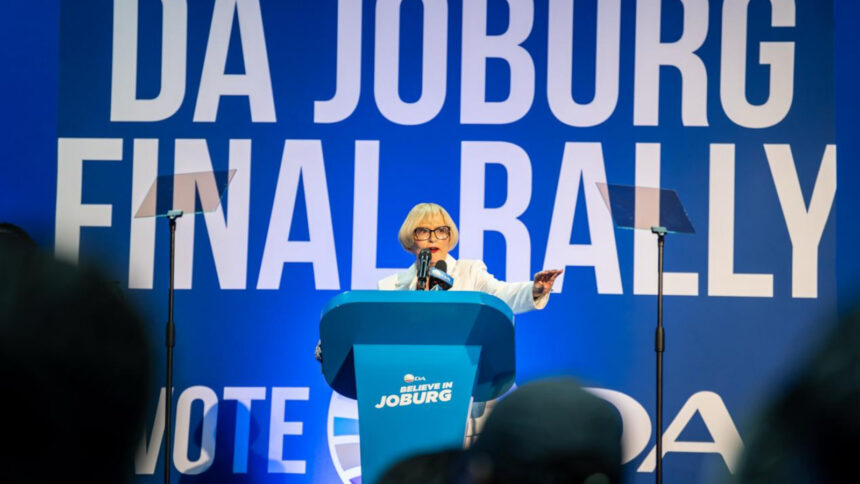
Winning Johannesburg could give the DA a platform to challenge for Gauteng in 2029, but it must convince voters that it offers more than an alternative to ANC failure, writes Zukile Majova in Real Politics.
The Democratic Alliance has never had a better opportunity to break through in Gauteng. The ANC is struggling to defend its record in Johannesburg, where years of unstable coalitions and deteriorating services have left residents desperate for a government that can make the city work again.
But the local government elections on 4 November are a test of whether the DA can turn the ANC’s decline into a credible campaign for power in Gauteng in 2029.
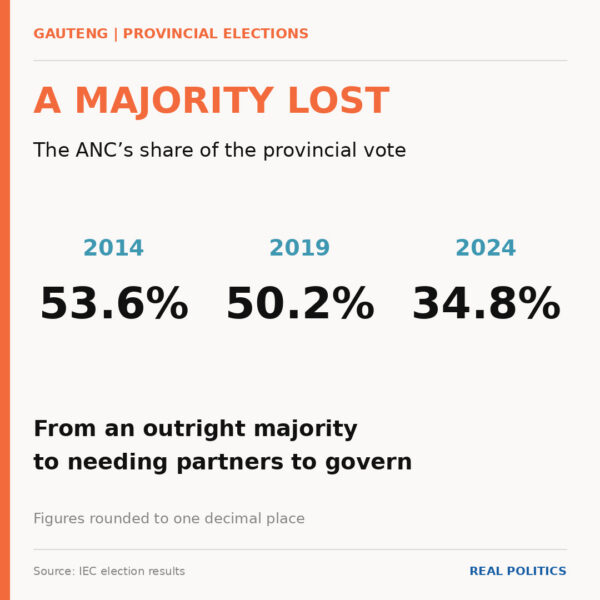
The DA’s ambition to take over Gauteng in 2029 is far from fanciful because the ANC’s provincial vote share has fallen from 53.6% in 2014 to 50.2% in 2019 and just 34.8% in 2024. That leaves the ANC with 28 of the legislature’s 80 seats and dependent on coalition partners to govern. The DA holds 22 seats on 27.4% of the vote.
The DA has made Helen Zille the face of its campaign to take Johannesburg, the country’s economic centre. If she wins, she could use the mayoralty to demonstrate that the party can govern a major city outside the Western Cape and build momentum for a campaign to take over Gauteng in 2029, possibly with Solly Msimanga as its candidate for premier.
If she fails, the DA will have to confront the uncomfortable question of what comes after Zille?
The party has a new federal leader in Geordin Hill-Lewis, but he remains mayor of Cape Town, a city where the DA has a strong electoral base. Msimanga is a senior party figure with experience in Gauteng, while Siviwe Gwarube has built a profile through her work in parliament and as education minister. Yet the DA has not demonstrated that any of them can command the national recognition and broad electoral appeal required to lead a credible challenge for power in 2029.
Hill-Lewis has chosen to remain in Cape Town rather than join the national executive. Governing Cape Town gives him an opportunity to demonstrate administrative competence. But it also leaves him politically anchored in the DA’s strongest province while his party participates in the government of national unity without its national leader in Cabinet.
The DA wants to be a dominant force in the national government by 2029. Its leader must therefore do more than manage a successful city. He must become a national political figure, capable of taking the fight to President Cyril Ramaphosa and the ANC on corruption, economic growth, jobs and the future of the country.
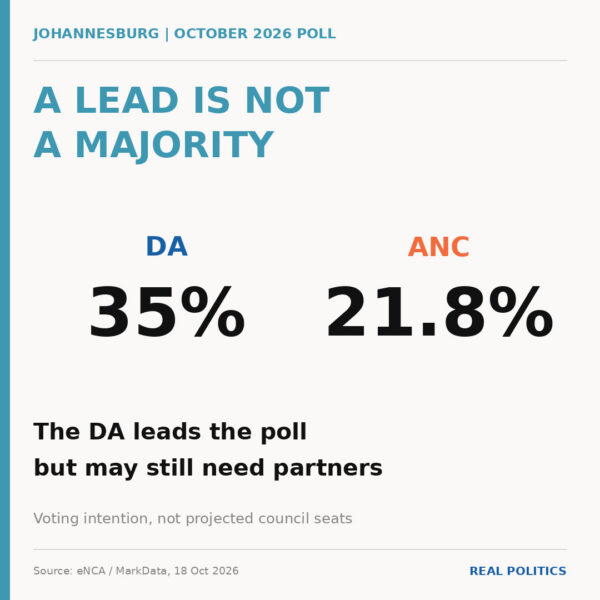
The polling suggests that Johannesburg is within reach. An eNCA-MarkData survey published in October put the DA on 35%, ahead of the ANC on 21.8%. The MK Party polled 12.5%, the EFF 11.9% and ActionSA 10.3%. A separate survey by the Social Research Foundation and The Common Sense put the DA on 36% and the ANC on 22%.
The numbers make the DA the clear frontrunner to emerge as the largest party in Johannesburg. They do not guarantee the mayoralty. With 270 council seats, an outright majority requires 136, and the polls suggest that the DA will need coalition partners.
The DA may win the most votes and still fail to assemble a governing majority. ActionSA, the IFP, the Freedom Front Plus, the Patriotic Alliance and smaller parties could become decisive in negotiations. The EFF and MK Party could also influence the outcome if the council is sufficiently fragmented.
The DA is wrong to assume that anger with the ANC will translate into support for itself. The party is asking voters to trust it to govern, while many remain unconvinced that its vision for South Africa adequately addresses the need for economic transformation.
For many black voters, the ANC remains the main party that appreciates the need to change the racial distribution of economic power.
The DA’s opposition to aspects of the existing black economic empowerment framework is a case in point. The party argues that BEE has enriched politically connected elites while failing to create sufficient jobs or lift the poor out of poverty. There is a legitimate debate to be had about the policy’s failures and whether its benefits have been distributed fairly.
But the failure of BEE is not proof that transformation is unnecessary. The Commission for Employment Equity’s latest report continues to show racial inequalities at the highest levels of management. Black South Africans remain under-represented in positions where decisions about investment, employment and ownership are made.
Replacing race-based redress with a needs-based approach may appeal to voters who believe that the ANC has used empowerment to reward its allies. But to voters who see race as a continuing determinant of access to economic power, the DA’s position risks looking less like a new route to transformation than a retreat from it.
The same political problem arises in healthcare and education. The DA opposes the ANC’s National Health Insurance model, but millions of South Africans depend on an overstretched public health system. They want to know how the party’s alternative will ensure access to specialists, modern equipment and quality treatment, not simply why the government’s proposal is wrong.
Education presents a similar challenge. The dispute over school governing bodies and language policy is not simply about institutional autonomy. It is also about whether black children can gain access to public schools that offer places and resources unavailable at nearby schools. For parents whose children must travel long distances because the closest school teaches in Afrikaans, the promise of non-racialism can feel hollow if the system cannot accommodate their needs.
That is the contradiction the DA must resolve if it wants to become a national governing party. It cannot rely indefinitely on the ANC’s failures. It must persuade voters that its own vision offers a credible answer to the inequalities that remain entrenched three decades after apartheid.
Even Cape Town, the DA’s showcase, cannot be exempt from that scrutiny. The city continues to face a severe housing backlog, sprawling informal settlements and gang violence in poor communities. The DA can point to the constraints under which municipalities operate, but it must also explain why so many residents remain excluded from the prosperity associated with the city it has governed for years.
None of this diminishes the opportunity before Zille. Johannesburg needs a government capable of restoring basic services, stabilising its finances and rebuilding public trust. The DA has made a credible case that it is ready to attempt that work.
But competence alone may not be enough to build the national coalition of voters the party needs.
The DA may still grow without winning Johannesburg. But it will have lost a rare chance to demonstrate that its ambitions extend beyond the Western Cape and that it can turn dissatisfaction with the ANC into a durable national movement.
That is why this is now or never for the DA.