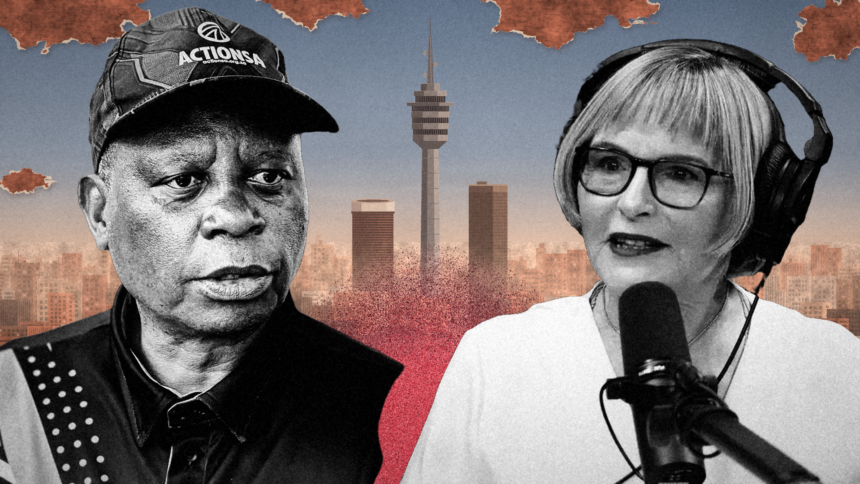
Helen Zille and Herman Mashaba have an opportunity to help stabilise Gauteng’s biggest cities, but their differences could stand in the way, writes Zukile Majova in Real Politics.
The political obstacle to stable governments in Gauteng’s three metropolitan municipalities is not just the arithmetic. It is Helen Zille and Herman Mashaba.

Two of the most recognisable figures to emerge from the 4 November local government elections now have an opportunity to shape the future of South Africa’s economic heartland. Whether they can put their differences aside may determine what happens to the votes cast by millions of Gauteng residents.
Zille led the Democratic Alliance’s campaign to take Johannesburg from the ANC. Mashaba’s ActionSA made substantial gains in Tshwane and Ekurhuleni and remains a central coalition player in Johannesburg. In Tshwane, it has become the second largest party.
Both have ambitions, both have strong personalities, and neither has been shy about criticising the other.

Yet the election has presented them with a proposition that is difficult to ignore. The DA is the biggest party in Johannesburg, Tshwane and Ekurhuleni. Together with ActionSA, the Freedom Front Plus and the Inkatha Freedom Party, it has a route to governing all three.
The numbers offer an opportunity for stability. They do not guarantee it.
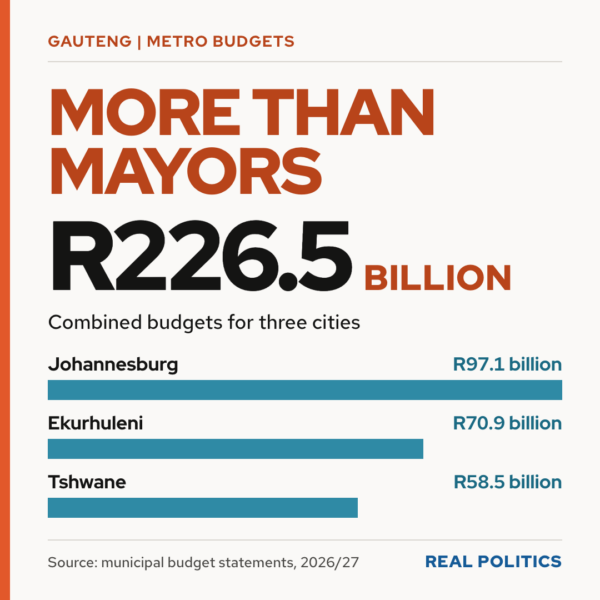
The cities’ published budgets for 2026/27 amount to R226.5-billion: Johannesburg accounts for R97.1-billion, Ekurhuleni R70.9-billion and Tshwane R58.5-billion. Their ability to maintain infrastructure, provide reliable services and attract investment has consequences far beyond their municipal boundaries.
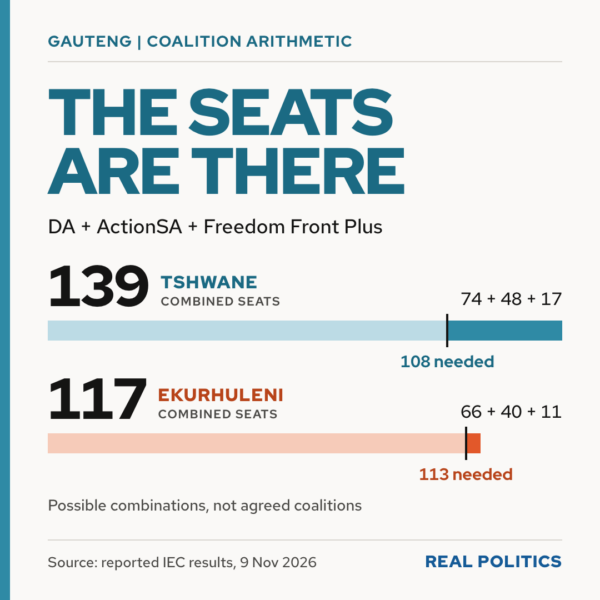
The arithmetic is particularly straightforward in Tshwane. The DA has 74 seats, ActionSA 48 and the Freedom Front Plus 17. Together they have 139 seats in a council of 214, where 108 constitute an outright majority. The DA and ActionSA alone have 122, so the Freedom Front Plus would provide an additional cushion.
In Ekurhuleni, the DA’s 66 seats and ActionSA’s 40 add up to 106. That is seven short of the 113 needed for an outright majority. The Freedom Front Plus, with 11 seats, takes the combination to 117.
In Johannesburg, the latest reported allocation gives the DA 91 seats, the ANC 63 and ActionSA 43. The DA and ActionSA would have 134 in the 270 seat council, two short of an outright majority. The IFP’s seven seats or the Freedom Front Plus’s five would take them over that threshold.
The IFP has worked with the DA in previous coalition administrations and won four Johannesburg wards in this election.

This is the opportunity in front of Zille and Mashaba. It is also where their personal differences become a political problem.
Their relationship has been fraught since Mashaba’s time as DA mayor of Johannesburg. He has accused Zille of undermining coalition stability, while she has criticised his record in office and his relationship with the EFF, which held the balance of power during his mayoralty.
Those disagreements have become part of the political identities of both leaders.
ActionSA reportedly wants the DA to consider Mashaba for the Johannesburg mayoralty instead of Zille. Its national chairperson, Michael Beaumont, has said the party remains open to a coalition with the DA, including one involving Zille, but that its concerns about her role in previous Johannesburg coalitions would have to be addressed.
Reports also indicate that ActionSA wants to retain the Tshwane mayoralty, held by Nasiphi Moya. The precise conditions remain part of the negotiations.
Mashaba also has another route. ActionSA has held talks with the ANC about continuing their partnership in Gauteng’s metros. An agreement involving the EFF and MK could allow it to retain Tshwane and secure significant influence in Johannesburg and Ekurhuleni.
The numbers explain why that alternative cannot be dismissed.
In Tshwane, the ANC’s 44 seats, ActionSA’s 48, the EFF’s 13 and MK’s four add up to 109, just above the 108 seat threshold. In Ekurhuleni, the same parties would have 128 seats, comfortably above the 113 needed.
On the latest reported Johannesburg allocation, they would have 138 seats, above the 136 needed for an outright majority.
These are possible combinations, not agreed coalitions. But they demonstrate that Mashaba has options and that Zille’s candidacy is not secured by the DA’s first place finish.
The largest party does not automatically get the mayoralty. Councillors elect the mayor, and parties that can assemble sufficient support can choose another candidate.
The consequences of getting these arrangements wrong are substantial. Gauteng’s metros oversee vast procurement budgets, electricity distribution, water systems, roads, housing and basic services. They also carry the burden of years of financial mismanagement, deteriorating infrastructure and allegations of corruption.
Ekurhuleni, in particular, will face pressure to confront allegations of wrongdoing and restore confidence in municipal institutions. The Madlanga Commission, which is examining allegations of criminal influence and interference in the criminal justice system, has reinforced the urgency of protecting public institutions.
A new municipal administration must be able to review suspicious contracts, commission forensic investigations, protect whistleblowers and refer evidence to the Hawks and the National Prosecuting Authority, the bodies responsible for investigating serious crime and bringing prosecutions.
A coalition that spends its first year fighting over mayoral positions and committee appointments would betray that urgency. The cities cannot afford another revolving door of mayors and municipal managers.
The voters have done their part. They have put the DA ahead in all three metros and given ActionSA enough seats to shape what happens next.
The DA’s time to prove itself will begin ticking the moment it takes office. If Zille becomes Johannesburg mayor, she will have until 2029 to demonstrate that the party can turn around the country’s largest city and make it the centrepiece of its campaign to win Gauteng and the presidency.
But that opportunity begins with an agreement capable of surviving beyond the election of a mayor.
Zille and Mashaba must decide whether their differences matter more than the cities they want to govern. Gauteng’s voters cannot afford to wait while they settle the argument.