The president took flak for spending R150 million on a commission, but shocking testimony shows the rot in the police runs deep, writes Zukile Majova in Real Politics.
President Cyril Ramaphosa was right to set up the Madlanga Commission of Inquiry into political interference in the police.
It may cost R150 million for six months of work, but the information being uncovered is worth every cent. If anything, the commission may be the country’s last chance to stop the full capture of the South African Police Service.
General Nhlanhla Mkhwanazi, the KwaZulu-Natal police commissioner, dropped shocking evidence as the first witness. He warned the commission that the SAPS is on the brink of collapse.
He said the system is so corrupt that even when he and national police commissioner General Fannie Masemola tried to raise alarms, Parliament and the president ignored them.
Desperate, Mkhwanazi held a press conference to expose how criminal networks were protected by top politicians.
He testified that at least 121 political killings cases in KwaZulu-Natal since 2017 were linked to hit squads protected by powerful politicians. In Gauteng, he said, senior officers abused state resources to help murder-accused underworld figure Katiso “KT” Molefe.
Officers reportedly registered private cars as municipal vehicles, fitted them with blue lights, and used them to move Molefe and his associates around.
Mkhwanazi also said DA MP Dianne Kohler Barnard broke the law by sharing secret intelligence.
He accused National Coloured Congress leader Fadiel Adams of getting and using classified material without authority.
SAPS spokesperson Brigadier Athlenda Mathe added even more chilling details. She said three guns recovered during an investigation were linked to 18 murder and attempted murder cases — including the killings of DJ Sumbody and DJ Vintos.
All this is old information that was more than enough for Ramaphosa to fire police minister Senzo Mchunu.
But the president held back. He feared losing support from Mchunu’s faction in the ANC, where Mchunu was being tipped as a future deputy president. So instead of acting for the country, he protected his political ally.
General Mkhwanazi had already accused Mchunu of disbanding a team that was investigating political killings. That team had uncovered links between politicians, drug cartels and corrupt officers.
Mkhwanazi said Mchunu broke the law by interfering in active cases and undermining police independence. He also accused the minister of sidelining General Masemola to bury at least 121 ongoing investigations.
This is not just corruption. It is organised crime with a political shield.
We are watching state capture 2.0 in real time — this time targeting the police.
Ramaphosa came to power promising to end state capture. He even said it was over. But the testimony at the Madlanga Commission shows that it never really stopped — it just moved to new departments with new players.
Former president Jacob Zuma was rightly blamed for the looting during the “nine wasted years”. But the rot did not end when he left.
What we are seeing now is the same pattern: well-connected criminals capture key departments — and where they can’t, they capture the politicians in charge.
The pattern is simple. Criminals buy influence. Politicians take the money, interfere with cases, and bully officials into giving contracts to friends and family.
The ladder of corruption goes from councillors to ministers, with no consequences.
Take businessman Vusumuzi “CAT” Matlala. He’s in court for allegedly trying to have his ex-girlfriend, actress Tebogo Thobejane, killed. He’s also accused of having powerful allies in the SAPS and political circles.
For over 10 years, Matlala reportedly funded the lifestyles of both Bheki Cele and Mchunu, who served as police ministers. He hosted them in luxury hotel suites and allegedly secured a R360 million tender through one of his companies.
That is how deep the rot runs.
The Zondo Commission already exposed how R600 million a year was looted from the Crime Intelligence secret fund. That was swept under the carpet.
Now we are hearing even more disturbing details — not from opposition parties or journalists, but from senior police officers themselves.
Ramaphosa has admitted that the evidence from the Madlanga Commission shocked him.
He has promised to act on its recommendations. He must do so. If not, South Africa’s law enforcement system will be lost completely — and so will the last shreds of public trust in government.
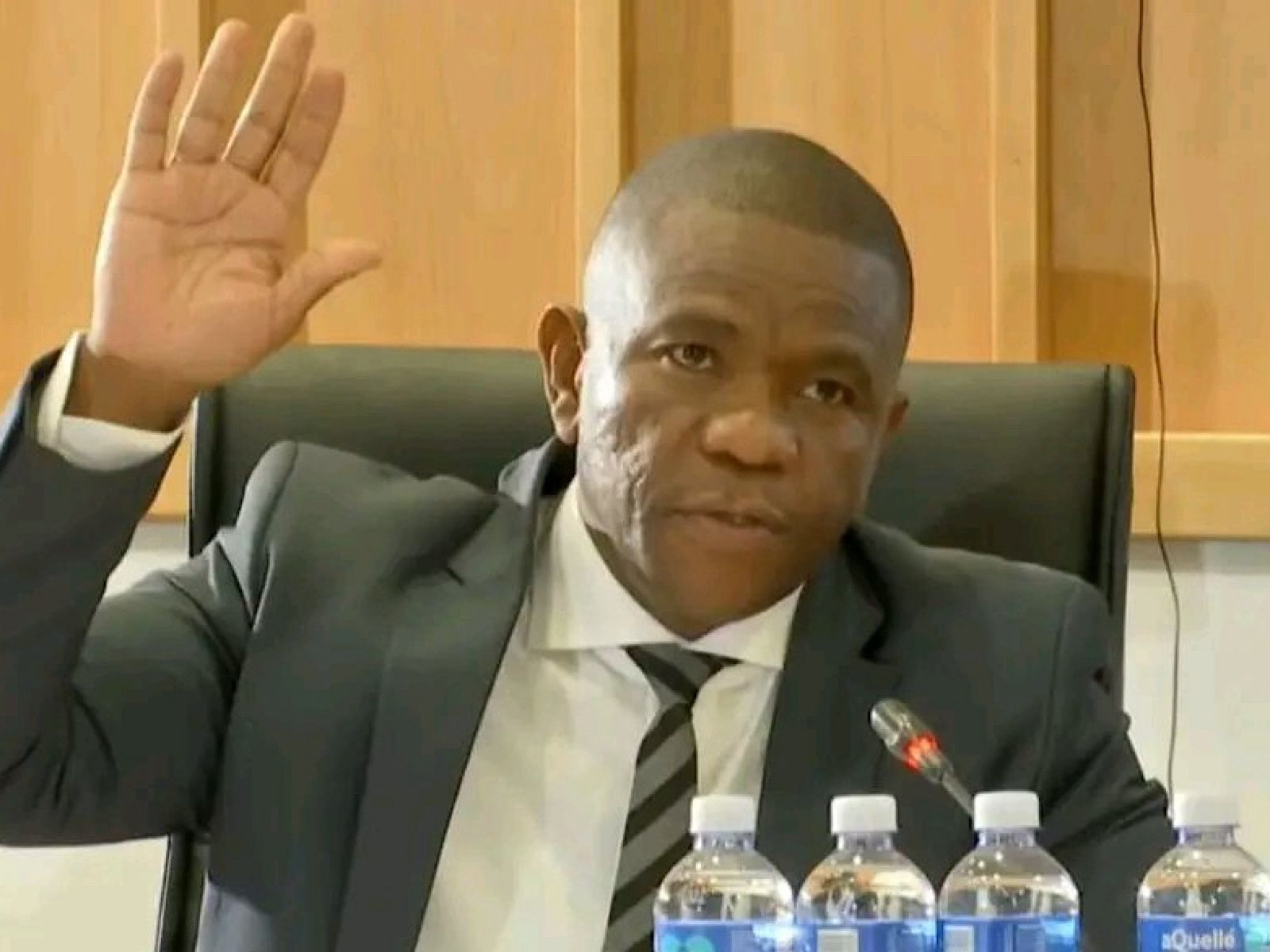
Pictured above: A screenshot of a video taken during the Madlanga Commission of Inquiry.
Image source: X