By Barry Christianson for Oxpeckers
Every year as spring approaches, the annual Fynbos Show held in Hopefield draws thousands of tourists to this critically biodiverse region in the Western Cape.
Local hotel owner Jacques van der Westhuisen says the festival draws up to 8,000 visitors and is a source of pride for residents. He collects as many species as he can find in the surrounding veld for an exhibition that forms part of the annual Hopefield Fynbos show.
But this year his attention has been drawn to a different kind of development on the edge of the town situated about 120km north of Cape Town. Phelan Green Group, a global renewable energy supplier owned by the Phelan family, from Ireland, has proposed a R47-billion green hydrogen (GH2) and electro-sustainable aviation fuel (eSAF) project that would place a 1.6GW solar farm and an industrial fuel plant on agricultural land beginning roughly a kilometre from Hopefield.
At full capacity, the project is expected to produce 140,000 tonnes of eSAF a year, for export to Europe. It will be developed in three phases, with the final phase expected to be completed in 2032.
The project’s footprint is significant: the solar component alone is expected to cover more than 3,000ha.
Residents are now asking whether Phelan’s promise of a green energy future comes at the expense of the region’s most valuable assets.
The small town of roughly 6,000 inhabitants is close to the West Coast National Park and Saldanha Bay’s Freeport Industrial Development Zone. It is a protected pocket surrounded by agricultural land. The only evidence of outside development are the slowly turning turbines of the nearby Umoya Wind Farm, which feeds renewable energy into the national grid.
Hopefield is part of the Saldanha Bay Municipality, identified in the West Coast Green Hydrogen Master Plan as a potential GH2 hub because of its renewable resources, existing industrial infrastructure and proximity to the Saldanha Bay Special Economic Zone.
The Western Cape government has ambitious plans for GH2, including facilitating up to 15GW of renewable energy for projects.
According to Oxpeckers #PowerTracker data, there are 16 GH2 projects, in various stages, throughout South Africa. Four of these, including Phelan’s solar/GH2 /eSAF project, are concentrated in the Western Cape. The combined estimated production output capacity of these, where quantified, is roughly 190,000 to 195,000 tonnes of GH2 (or its direct fuel derivatives) per year.
While smaller proof-of-concept projects have been demonstrated, commercial output of GH2 is not yet active in the Western Cape.
A related concern is the rise in mining applications for phosphate in the region. In early 2025, non-profit organisation Protect the West Coast raised environmental concerns about an application to mine phosphates on a farm near Langebaan, which is just 35km from Hopefield. The project received environmental authorisation from the Western Cape Department of Minerals and Petroleum Resources on July 24 2026.
There is also the Kropz Elandsfontein phosphate mine, right outside the town. It has the overall capacity to produce between one million and 1.5-million tonnes of phosphate rock concentrate each year.
These activities are directly linked to GH2: nitrogen can be combined with GH2 to produce green ammonia, which is then used as an energy carrier and fuel.
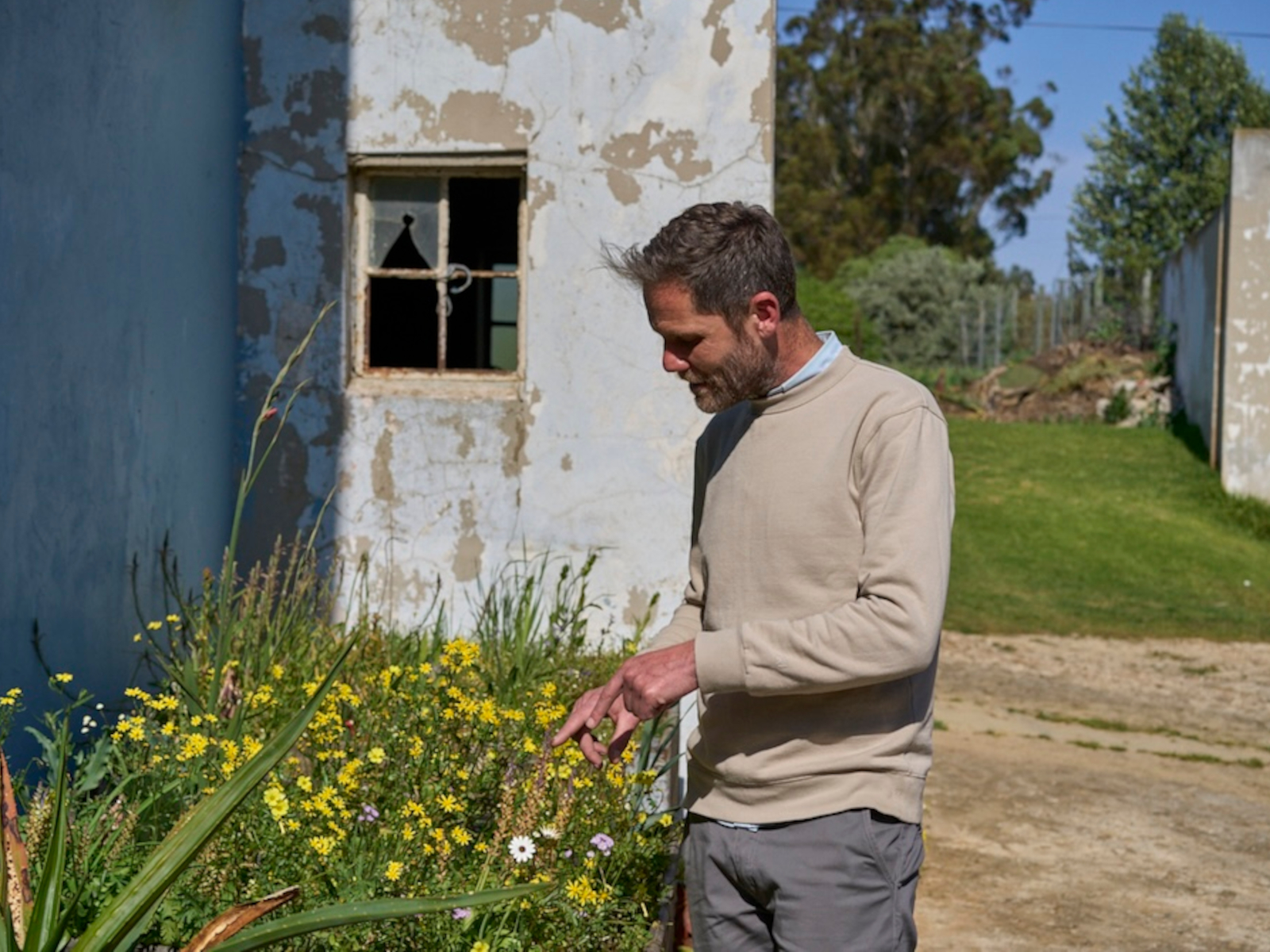
Pictured above: Hopefield hotel owner Jacques van der Westhuisen points to fynbos growing in the veld around the town, where he has collected species for an exhibition at the annual Fynbos Show.
Image source: Barry Christianson