
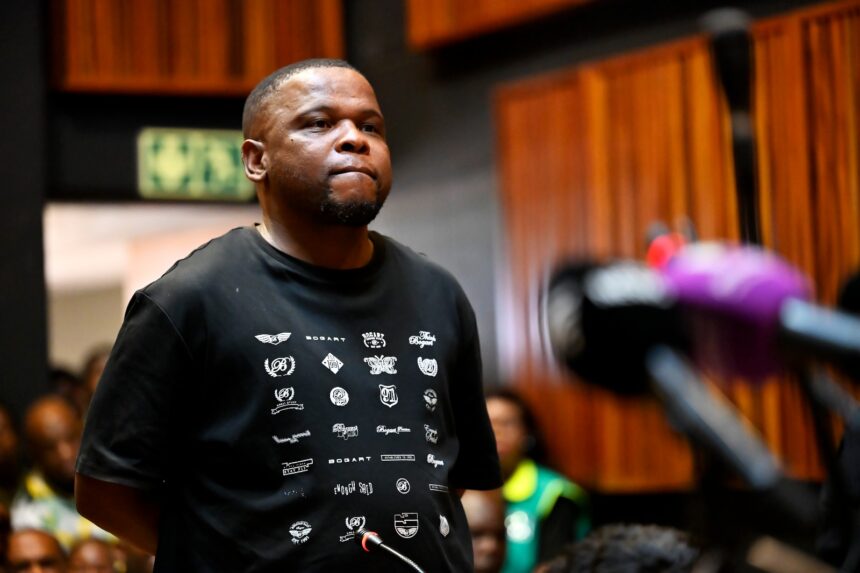
- Fannie John Sibeko appeared in Palm Ridge Magistrate’s Court on Thursday, facing four murder charges after a shooting involving African National Congress supporters in Katlehong.
- Angry families and political supporters packed the courtroom as Sibeko faced charges linked to a shooting that killed four people and wounded three others.
The anger inside Palm Ridge Magistrate’s Court on Thursday was impossible to ignore.
Every seat in the courtroom was taken as Fannie John Sibeko made his first appearance on 15 October 2026.
Four people were dead, three others were wounded and a township with a bloody history of political violence was once again mourning its own.
Grieving families, community members and political supporters packed the public gallery. Their anger followed Sibeko as he walked towards the holding cells.
“He is evil,” someone shouted from the gallery.
Others shouted that he “should have rather shot at them”.
Sibeko frowned and continued walking down to the holding cells.
The courtroom scenes showed the depth of anger following the shooting that claimed four lives in Katlehong, east of Johannesburg.
Sibeko faces four counts of murder, three counts of attempted murder, discharging a firearm in a public place and failing to safeguard a firearm.
The shooting happened on 13 October 2026 in Sophangisa Street.
A group of African National Congress (ANC) supporters were returning from a memorial service for the late branch chairperson and community leader Jeanette Magugu when gunfire broke out.
Four people lost their lives and three others were wounded.
The victims included members of the African National Congress Youth League (ANCYL).
What should have been a gathering to remember a community leader ended in bloodshed.
The killings have brought painful memories back to Katlehong, a township where political differences once turned streets, hostels and railway lines into killing grounds.
Between 1990 and 1994, Katlehong was among the communities hardest hit by political violence during South Africa’s move towards democracy.
Supporters of the ANC and the Inkatha Freedom Party (IFP) fought deadly battles.
Township residents, many of whom supported the ANC clashed with hostel dwellers who largely backed the IFP.
Armed groups fought for control of neighbourhoods. Families lived in fear and ordinary people became victims of a political war.
Young residents formed self-defence groups while hostel residents organised their own armed units.
The violence spread to commuter trains, where passengers faced shootings, stabbings and attacks.
In December 1993, 11 people, most of them ANCYL members, were kidnapped and killed in Katlehong’s Moleleki section.
The Truth and Reconciliation Commission (TRC) later heard evidence of how apartheid security forces helped fuel political violence during those years.
More than three decades later, the latest killings have raised troubling questions about whether Katlehong has truly escaped its violent past.
The circumstances are different and the motive behind the latest shooting has not been established. But the sight of political supporters being killed after a memorial service has brought old fears back into focus.
The case has been handed to the Gauteng Political Killings Task Team for investigation.
Afrika Mayibuye, led by Floyd Shivambu, has meanwhile rejected claims linking Sibeko to the movement as a councillor candidate.
In a statement, the movement said: “The individual concerned is not a Mayibuye councillor and none of our councillor candidates are implicated in wrongdoing in this incident.”
The movement also condemned the reckless use of guns at funerals, memorial services and celebrations.
It said grief, celebration and political affiliation could never justify firing guns in a way that puts lives at risk.
The movement called for an end to the practice of firing shots into the air.
For the families who filled the courtroom, however, the damage has already been done.
Four lives have been lost and three people are recovering from gunshot wounds.
Sibeko remains accused of the crimes. The court has not found him guilty.
But the anger in the gallery was a reminder that the wounds left by political violence do not easily heal.
Katlehong has buried victims of political bloodshed before.
The question now is how many more lives will be lost before the township can finally leave that history behind.
The accused will return to court on 22 October 2026.