
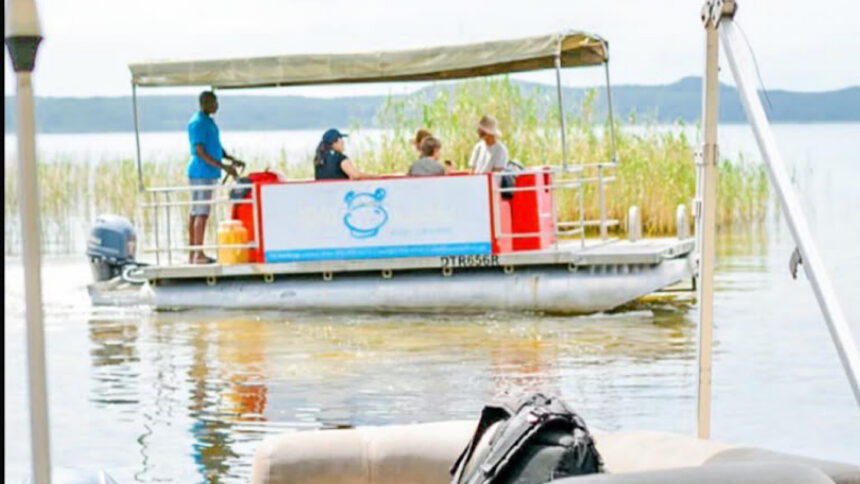
- Police boats transported election materials across waters inhabited by crocodiles and hippos to eNkovukeni, where 193 people were reportedly registered to vote.
- Residents have demanded a bridge for years, but former KwaZulu-Natal Premier Nomusa MaDube-Ncube said in 2024 that the government had no plans to build one.
For years, residents of eNkovukeni in northern KwaZulu-Natal have begged for a bridge to connect them to the outside world.
But on Wednesday, 4 November, police boats were once again needed to carry election materials across waters inhabited by crocodiles and hippos.
The remote village, which falls under the uMhlabuyalingana local municipality in the uMkhanyakude district, has struggled with access to basic services for years.
According to information provided by the municipality, 193 people were registered to vote in the community, including those who applied for special votes.
The South African Police Service deployed boats to help the Electoral Commission transport election materials across the water.
The operation brought attention back to a problem residents have raised for more than a decade.
They have long complained that they are forgotten by the government and only remembered when elections arrive.
In 2021, residents protested against the lack of a bridge and threatened to boycott the local government elections.
They complained that the safety of wild animals appeared to matter more to authorities than the lives of people living in the community.
Residents said politicians had repeatedly promised to improve access to the village, but their daily struggle continued.
The fight for a bridge goes back even further.
In 2016, national transport officials discussed the community’s request for a permanent bridge and the need to find a lasting solution.
Boats were supplied that year to help residents cross the water.
But the bridge residents wanted was never built.
In June 2024, then KwaZulu-Natal Premier Nomusa MaDube-Ncube said the government had no plans to build a bridge because the community was located within the iSimangaliso Wetland Park.
Her statement dealt another blow to residents who had spent years asking for a safer way to reach the mainland.
Now, another local government election has arrived, and the community still depends on boats to cross the water.
While election officials worked to get voting materials to eNkovukeni on Wednesday, some residents continued with their daily lives.
People were seen fishing in the lake to find food for their families.
uMkhanyakude District Municipality spokesperson Nonhlanhla Jele praised the efforts to make voting possible despite the village’s location.
“In a remarkable logistical operation, South African Police Service boats were deployed to ferry Independent Electoral Commission election materials across the lake to the island, ensuring that electoral operations could proceed smoothly despite the community’s geographical isolation,” said Jele.
She said people living in remote areas should also have the chance to take part in elections.
“Despite the geographical challenges, the people of eNkovukeni are demonstrating that no community is too remote to participate in democracy. Their participation is a powerful reminder that every vote counts and that no citizen should be left behind in the democratic process,” she said.
According to the report from the village, voting was completed at around 2.30pm, making eNkovukeni one of the first communities in the province to finish casting ballots.
But while the police boats helped election officials reach voters, the community’s transport problems remain.
For residents, getting ballot papers across the water is only one part of the struggle.
They also need a reliable way to reach services on the mainland throughout the year.
The government has previously supplied boats and ruled out building a bridge, but the community’s concerns about access have not gone away.
Wednesday’s election showed that officials could arrange transport to reach this isolated community.
For the people who live there, the challenge is having safe and reliable transport long after election day.