By Scrolla Reporters
They passed with flying colours.
But that’s no guarantee for a university education in Mzansi.
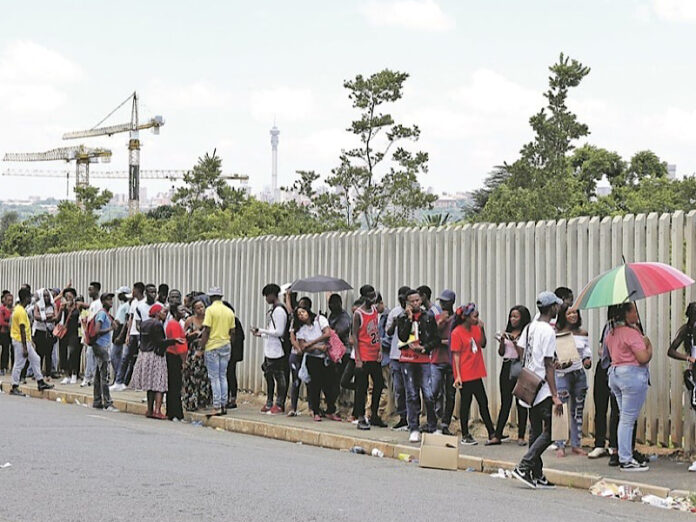
Thousands of post matric learners stood in pouring rain in various campuses of Walter Sisulu University in the Eastern Cape, while others battled a heatwave in KwaZulu-Natal.
It’s the harsh reality of seeking a university or college education in South Africa that greeted the class of 2022 this week.
Walter Sisulu University received over 500,000 applications for 7,000 available spaces.
Other universities have closed their gates to “walk-ins”.
The University of Johannesburg, which will accept 10,500 first-year students, said all applications are now done online.
This is an immediate headache for thousands of matriculants from state-owned schools who, even after 12 years of schooling, leave school without any form of computer literacy.
Some 278,000 matrics qualify to enter into bachelor degree programmes.
The University of Pretoria told Scrolla.Africa the institution would not be accepting any late applicants this year.
“At the University of Pretoria, we have the necessary processes in place to deal with the shorter deadlines caused by delayed results,” said spokesperson Drikus Delport.
“More than 44,000 applications were received from first year undergraduate students. These are students who meet the university’s minimum requirements.”
Cape Peninsula University of Technology said it’s a first come first served system that prioritises students who applied last year.
“Late applications are not currently open as the institution is first considering the matrics who applied on time but were waiting on their final results to be released. Once that process is done then we will consider late applications in courses that have room.”
Walter Sisulu University in the Eastern Cape, which accepts the largest number of students from historically disadvantaged backgrounds, said it is waiting for the National Student Financial Aid Scheme (NSFAS) to confirm funding for the prospective students.
“The biggest challenge for our first-time and returning students is a delay in the confirmation of NSFAS funding. Many of our students are unable to register, as you’ll remember that 70% of our student population is funded by NSFAS,” the institution’s spokesperson, Yonela Tukwayo, told Scrolla.Africa.
The University of KwaZulu-Natal has received over 300,000 applications for 8,500 available spaces.
As such it is not accepting walk-ins this year.
Durban University of Technology is currently registering post-graduate students.
Wits University’s senior communications officer Buhle Zuma told the media they received more than 100,000 applications for 6,000 first-year places.
On Tuesday Higher Education and Training Minister, Blade Nzimande, said registrations for the 2023 academic year started on 16 January and will close on 20 February.
“People who want to go to these universities must not relax. If you relax, they may lose the opportunity,” he said at a media briefing.
Pictured above: Students lined up outside of the University of Johannesburg in the hopes of securing a spot
Image source: City Press