
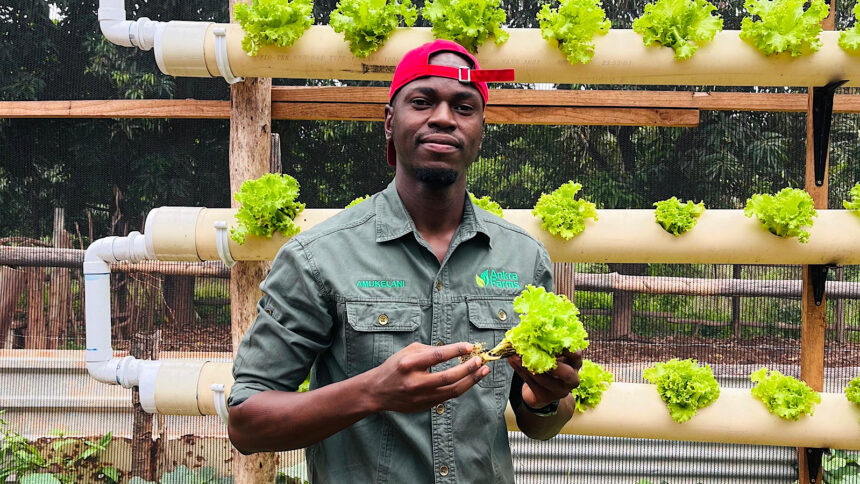
- At Ankra Farms near Tzaneen, a pump sends water from a tank through rows of leafy greens and back again.
- Nkanyana used his savings to buy equipment. He now charges students R450 for three months of training and hopes to expand the farm.
When Amukelani Nkanyana lifts the lid of a black tank at his farm near Tzaneen, he can show you how he waters a whole stand of lettuce. A small pump sends water to the top row. By the time it reaches the bottom, it is on its way back to the tank.
Nkanyana, 34, has spent the past year growing vegetables this way at Ankra Farms in Mariveni village, Limpopo. Water shortages at home got him interested in hydroponics, a way to grow crops without soil by supplying their roots with water and nutrients.
“Being an inquisitive person, I started doing research about other ways of farming with less water, as in my village we had water issues,” he said.
Nkanyana studied agricultural science at the University of Limpopo. When he struggled to find work, he started a business called Ankra Studios. He later used his savings to buy equipment for the farm.
Under shade netting, he grows Vera lettuce, a loose-leaf variety, in rows of white pipes stacked one above the other. He has also grown spinach and coriander.
In a video he supplied to Scrolla.Africa, Nkanyana traces the route the water takes from the pump to the top pipe. The water carries nutrients past the roots, trickles down through the rows and drains back into the tank, ready to go round again.
For Nkanyana, being able to reuse that water is what makes the system worth pursuing in a village where water can be hard to come by.
He sells his produce and teaches students how to grow vegetables this way. Three months of training costs R450. His next goal is to expand Ankra Farms, a step he estimates will cost between R500,000 and R1-million.