
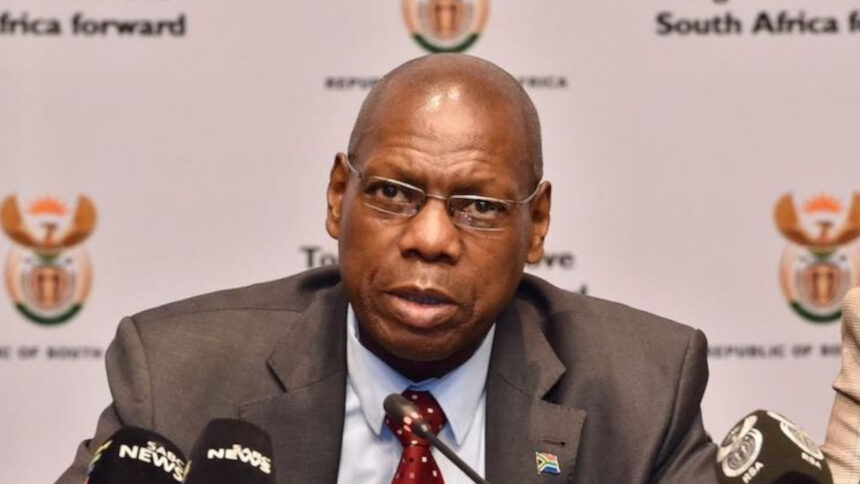
Zweli Mkhize could help the ANC recover support lost to Jacob Zuma in KwaZulu Natal while strengthening his own influence ahead of the party’s 2027 leadership conference, writes Zukile Majova in Real Politics.
If the next serious challenge to Cyril Ramaphosa’s authority inside the ANC emerges from KwaZulu Natal, the seeds may already be visible.
That is the paradox confronting the ANC ahead of the November 4 local government elections. The politician who may be best equipped to help it recover from Jacob Zuma’s assault on its KZN support base has already demonstrated that he can build a formidable national challenge to Ramaphosa.
That politician is Zweli Mkhize. The timing could hardly be more awkward.
The local elections fall just over a year before the ANC’s December 2027 elective conference, where delegates choose the party’s leadership. Their significance therefore extends far beyond municipalities.
Inside Luthuli House, the ANC’s headquarters, the results will be read as a measure of which leaders have momentum, which provinces remain loyal and who can still mobilise voters and branches.
Nowhere will that calculation matter more than in KZN.
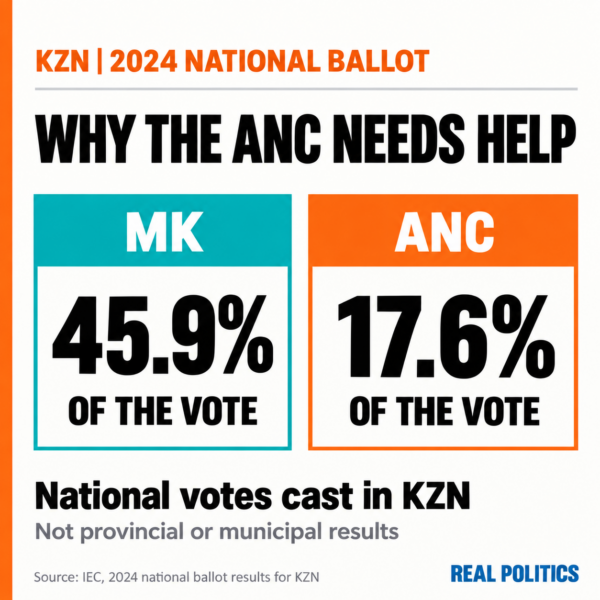
Zuma’s uMkhonto weSizwe party, known as MK, has transformed the province from an ANC fortress into its most dangerous electoral battlefield. On the national ballot in KZN in 2024, the ANC received just 17.6%, while MK took almost 46%.
Recent polling suggests MK remains strong in eThekwini, although polls should not be confused with election results.
The ANC knows it has a Zuma problem. It reportedly plans to deploy veterans, including Mkhize and Nkosazana Dlamini Zuma, to counter his influence.
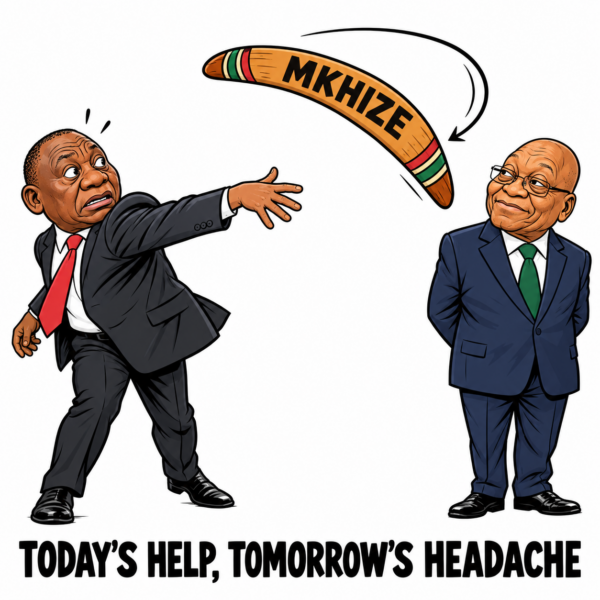
And there lies the contradiction. Mkhize could be the ANC’s antidote to Zuma. He could also become an antidote to Ramaphosa’s dominance of the ANC.
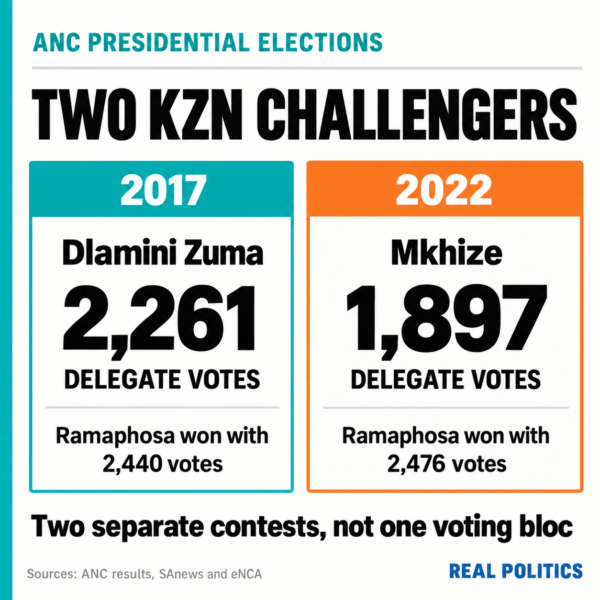
In 2017, Ramaphosa defeated Dlamini Zuma, the former African Union Commission chair, by 2,440 votes to 2,261. Five years later, Mkhize received 1,897 votes against Ramaphosa’s 2,476.
Two consecutive ANC conferences. Two major challengers with deep KZN political roots. Twice, Ramaphosa confronted a candidate capable of attracting a substantial share of the delegates.
That makes Mkhize’s deployment much bigger than a municipal campaign.
There is another reason why the question resonates in KZN.
Among sections of the province’s ANC establishment, there is a perception that the Ramaphosa faction has progressively marginalised its old political heavyweights from the centre of national ANC power.
This does not mean every KZN leader has been removed or that there is a formal policy to exclude the province. The perception is that the process is subtler, and potentially more politically damaging.
Then there is the treatment of ANC veterans.
Mavuso Msimang, born in Edendale, Pietermaritzburg, spent six decades in the ANC and was elected deputy president of its Veterans League in 2023. The former senior civil servant and liberation veteran was hardly a political lightweight.
He resigned in December that year, accusing the organisation of corruption, nepotism and incompetence. His resignation followed ANC secretary general Fikile Mbalula’s public warning against veterans campaigning against the party.
Mbalula later acknowledged that his comments had impugned Msimang’s integrity and apologised. The ANC subsequently announced that Msimang had agreed to withdraw his resignation.
The episode matters because Msimang was precisely the sort of elder whose institutional memory should have been an asset to a party fighting for survival. Instead, it became another symbol of the uneasy relationship between the current leadership and sections of the old guard.
KZN’s bench of prominent political figures is further complicated by the Madlanga Commission, which is investigating allegations of criminal infiltration and interference in the criminal justice system.
The province’s most recognisable figures aligned with the current leadership include police minister Senzo Mchunu, who is on special leave, and former police minister Bheki Cele. Neither is ideally positioned to become the reassuring public face of an ANC campaign.
Mchunu’s leave and the allegations under examination have constrained him politically. During preliminary parliamentary committee deliberations, members said the evidence before them did not establish a corrupt relationship between him and Vusimuzi “Cat” Matlala, who faces criminal charges. Other members argued that concerns still required investigation.
That is not the same as a final determination of every allegation.
Cele faces a further political cloud. The Madlanga Commission has heard allegations that Crime Intelligence funds were diverted to him. Matlala has also made allegations about their dealings before Parliament’s committee.
Cele has denied receiving money from Matlala. The allegations remain untested in court, but reports that a police forensic investigation has recommended his prosecution over alleged benefits from Matlala further complicate his position.
This leaves the ANC with an extraordinary problem.
At the moment it needs a heavyweight KZN politician who can speak credibly to voters drawn to Zuma, some of its most recognisable figures are sidelined, embroiled in factional controversy or constrained by investigations.
Which brings us back to Mkhize.
He offers something the ANC desperately needs: political credibility in KZN without being Jacob Zuma.
He has been premier, ANC treasurer general and health minister. He knows the province’s political and traditional structures and has a family connection to the Zulu royal household.
His tenure as health minister nevertheless ended amid the Digital Vibes contracting scandal, in which he has denied wrongdoing.
His greatest political asset, and potentially his greatest liability for the Ramaphosa faction, is his demonstrated capacity to command support beyond KZN.
Mkhize does not have to be invented as a challenger. He has already been one.
That is why a possible convergence between Mkhize and Dlamini Zuma deserves watching.
There is no evidence that such an alliance currently exists. But their performances in the last two leadership contests are striking. Dlamini Zuma nearly defeated Ramaphosa in 2017. Mkhize secured 43.38% of the valid presidential votes in 2022.
Those were separate contests, not voting blocs that can simply be added together. But if their political networks converged around a common candidate or project before 2027, they could unite constituencies that previously challenged Ramaphosa separately.
That would not automatically produce a new ANC president. Conferences are unpredictable, and alliances that look logical from outside often collapse when delegates begin counting numbers.
But it could change the balance of power. If Mkhize helps the ANC improve significantly in KZN, he emerges with renewed political stature.
The ANC has another reservoir of political capital it seems reluctant to fully exploit.
Mathews Phosa, Tokyo Sexwale, Phumzile Mlambo Ngcuka, Trevor Manuel and Thabo Mbeki represent different strands of its history. Collectively, they possess credibility accumulated over decades in government, business, international institutions and the liberation movement.
Some remain influential in the private sector. Others have extensive international networks.
Why are they not more visible in a campaign where the ANC needs to reassure business, investors and professionals that it remains capable of renewal?
The answer may partly lie in the uneasy relationship between the current leadership and its predecessors.
Mbalula’s public warning this year that veterans should stop criticising the leadership revealed that sensitivity. He specifically mentioned Mbeki and acknowledged criticism from Phosa and Msimang.
The ANC needs the authority of its history precisely when it appears least comfortable with some of the people who embody it.
Zuma understands the value of political memory. MK has presented itself as the custodian of a particular version of ANC and liberation history while campaigning against the ANC itself.
To counter that, the ANC needs people who can speak convincingly about where the movement came from, why it lost its way and why voters should believe it can recover.
In KZN, Mkhize may be the most obvious bridge between that history and the present.
But bridges can be crossed in both directions.
Ramaphosa may need Mkhize to fight Zuma. The ANC may need him to recover KZN. If he succeeds, however, he could arrive at the 2027 conference with renewed political authority.
The irony is that the ANC’s most effective weapon against Zuma may also be the politician whose success most complicates Ramaphosa’s final stretch as party president.