By Selloane Ntshonyane
- The 1 Million Swimmers Africa initiative launched in Klipspruit, Soweto, on 22 September, offering free swimming and water safety lessons.
- Founders Tumi Masekela and Jamal Hill aim to teach 10,000 people to swim by 2027, starting with 20 new swim instructors in October.
Swimming is the only sport that can save your life. That’s the message behind a new programme launched in Soweto this week, aiming to teach thousands of South Africans, many of whom have never had the chance, how to swim.
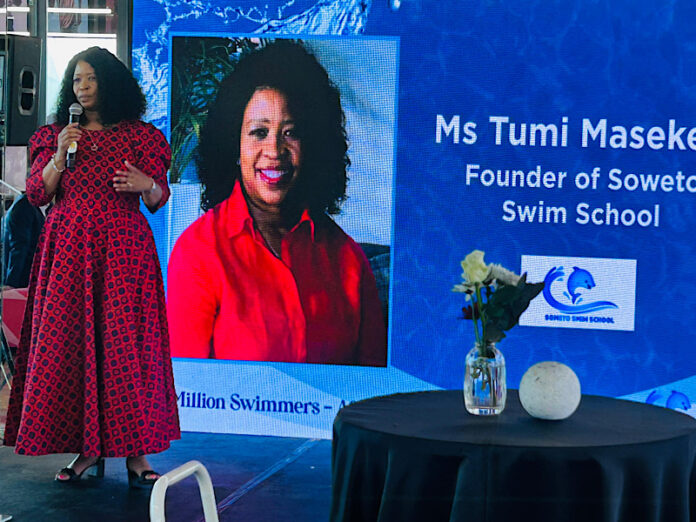
The 1 Million Swimmers Africa initiative launched on Tuesday, 22 September, in Klipspruit, Soweto. It is run by Tumi Masekela, founder of Soweto Swim School, and Jamal Hill, an American Paralympic medallist and founder of the Swim Up Hill Foundation. The programme aims to make swimming and water safety accessible to communities that have little or no access to lessons, for free.
South Africa records an average of 1,477 fatal drownings a year, according to the 1 Million Swimmers Africa website, including 30% among children under 14. The website also states that 51 million people in South Africa lack basic water safety skills.
Hill said swimming carries a weight no other sport does.
“As far as sports can go, swimming is the only sport that has the potential to save one’s life,” he said.
He told Scrolla.Africa the programme is built around making swimming education accessible from home, before a child ever enters a pool.
“What we’ve been able to do is create a system that allows children and parents to begin that swimming education at home. So as long as they have access to clean drinking water and a bowl, they can already start to practice prerequisites that are going to be necessary once they enter the pool environment,” Hill said.
Cost remains one of the biggest barriers. Masekela said standard swimming lessons in South Africa typically cost between R1,000 and R1,200 a month. Her own school has kept its prices far lower for the past four years, R100 for annual registration, R400 a month for children, and R550 for four lessons for adults, specifically to keep swimming within reach of ordinary households.
“The school has kept the same prices for the past four years because we want to make swimming affordable for the normal household and we want to create access,” Masekela said.
She said some families have to choose between buying food and paying for swimming lessons, a choice Diako Sekobolo, 37, from Soweto, knows well.
Sekobolo’s 7-year-old daughter has never had a swimming lesson. As an unemployed mother whose daughter’s father already covers rent, food and other needs, the cost has never even felt like an option to consider.
“I would never be able to afford swimming lessons because I’m unemployed and the father of my daughter is the sole provider,” she said.
Sekobolo said free lessons would mean a great deal to her family, not just for leisure, but because swimming can help a child survive an accident.
Masekela said the programme will also train 20 young people as swimming instructors, starting in October, and aims to teach its first 10,000 people to swim by 2027.
Pictured above:
Image source: Selloane Ntshonyane