By Nontokozo Gemani
- Martha Moloi, 78, lives in Tsakane and receives R2,420 a month through the Older Persons Grant, supporting her unemployed daughter.
- Every month when her grant runs out, Moloi borrows from a mashonisa who charges her fifty percent interest to repay.
Every month, when her SASSA grant runs out before the next payment, Martha Moloi has to borrow from a mashonisa just to get by.
She says R100 borrowed becomes R150 to repay, and R200 becomes R300. It happens every month.
Moloi is 78 and lives in Tsakane. She receives R2,420 a month through the Older Persons Grant, and spends about R1,300 of it on groceries for herself and her unemployed daughter.
“Things were better in the past years. I used to buy R600 worth of groceries and it lasted the whole month, for four people,” she says. Now, even with two people in the household, R1,300 does not last.
From April 2026, the Older Persons Grant increased to R2,400, while beneficiaries older than 75 receive R2,420. The Child Support Grant increased by R20 to R580, and the SRD grant remains at R370.
Her shopping list has been reduced to maize meal, sugar, flour, rice, teabags, fish oil, butter and a few spices. Meat has become chicken feet, gizzards and necks.
“We no longer eat beef. We don’t even know how it tastes like now, because it’s too expensive,” she says.
Items she once bought without thinking are now off the list entirely: tomato sauce, mayonnaise, Worcestershire sauce, Aromat, eggs, cheese, Russians and oats. Coffee is bought only when Shoprite runs a special.
“Eating nice is no longer there. We are just eating to drink pills and to be full,” Moloi says.
It isn’t only food. Her burial society contributions have increased from about R200 to R230, and she pays R100 for church and R150 for DStv each month.
She tries to keep some money aside for clinic visits, but some medicines, such as ointments and ulcer tablets, are not available at the clinic and have to be bought from a pharmacy.
“I don’t know when last I bought a dress or a t-shirt for myself, because all the money goes to groceries and other expenses,” she says.
To stretch her budget, Moloi buys a big tub of peanut butter and R10 loaves of bread from Boxer for afternoons, with porridge in the mornings. She has also stopped contributing to her December and savings stokvels because she can no longer afford them.
“We are grateful for the grant money,” she says, “but 2025 and 2026 have been very expensive.”
Thirty-year-old Zanele Kubheka is facing a similar struggle while raising her nine-year-old child.
Kubheka receives the R370 SRD grant and the R580 Child Support Grant. She studied at college but has been unable to find work, and has started selling ice blocks in her neighbourhood, though the business brings in little profit.
She uses the Child Support Grant to buy a R390 Shoprite hamper containing 10kg maize meal, flour and rice, which she and her child stretch for up to three months.
“Everything is expensive, and I always have to choose every month which basic is the most important,” she says.
She adds R150 worth of meat from a local butcher and uses the rest for toiletries. When the SRD grant arrives, she buys vegetables such as cabbage, spinach and potatoes.
“Back in 2023, I used to buy groceries that lasted me and my late grandmother almost the whole month. Now I can’t even afford to buy biscuits and Danone for my kid,” she says.
Shoprite and Boxer specials have become important to her, but emergencies can quickly derail her budget.
“It is so difficult when there’s an emergency that requires money, because I can’t even save anything to look out for myself during the month,” she says.
The Pietermaritzburg Economic Justice and Dignity Group found in February 2026, before the April increase, that the R560 Child Support Grant was 35% below the food poverty line, and 41% below the estimated cost of giving a child a basic nutritious diet.
Food price increases have slowed. Statistics South Africa says food and non-alcoholic beverage inflation dropped to 0.9% in July 2026, its lowest level in more than sixteen years. Cereal prices fell 2% year on year, while maize meal prices fell 3.1% month on month.
But lower food inflation does not mean food has become affordable for households living on grants. For Moloi and Kubheka, the question every month is whether their money can cover food and other basic costs until the next payment.
Items that once formed part of an ordinary grocery shop, eggs, meat, sauces and snacks for a child, have become luxuries. For both women, the grants remain essential, but making it to the next payment remains a monthly struggle.
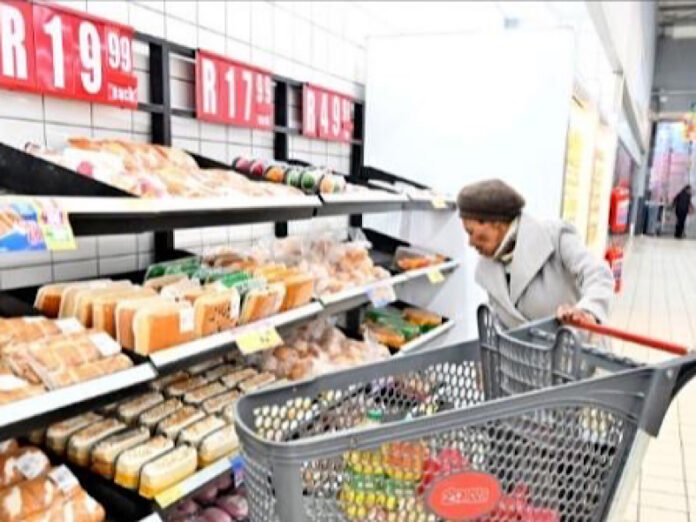
Pictured above: Many SASSA grant beneficiaries are struggling to stretch their grants to last them till month end.
Image source: Nontokozo Gemani